
Interested in this Data Scientist role at American Sugar Refining, Inc.?
Apply Now →Skills & Technologies
About This Role
Location:
Belle Glade, FL, US
\#job\-location.job\-location\-inline { display: inline; }
Req ID: 41547
Date: Jul 1, 2026
.buttontextd41d9d2b38d48ca9 a{ border: 1px solid transparent; } .buttontextd41d9d2b38d48ca9 a: focus{ border: 1px dashed \#00904c !important; outline: none !important; }
Florida Crystals Corporation is a fully integrated cane sugar company. Florida Crystals regeneratively farms sugarcane and rice in South Florida, where it owns two sugar mills, a sugar refinery, a packaging and distribution center, Florida's only rice mill, a compost facility, and one of the largest renewable power plants of its kind in the U.S., which uses sugarcane fiber to generate eco\-friendly energy that powers its sugar operations. Florida Crystals owns one of the largest Regenerative Organic Certified® farms in the U.S. and its Florida Crystals® products are the only ROC™ sugar grown and milled sugar in the country. Florida Crystals owns ASR Group International, Inc., a holding company that conducts operations through its subsidiaries. The ASR Group® family of companies make up the world’s largest refiner and marketer of cane sugar. Florida Crystals is headquartered in West Palm Beach, Florida. Learn more at www.FloridaCrystalsCorp.com.
OVERVIEW
Reporting to the VP of R\&D, the Senior Data Scientist will serve as a high\-level technical contributor within the R\&D group, leading the design, development, validation, and implementation of advanced artificial intelligence (AI), machine learning, and data science solutions that improve sugarcane research and operational decision\-making. This role is intended for a highly capable professional with graduate\-level training, who can translate complex agricultural and industrial problems into scalable analytics products, predictive models, and decision\-support tools. The position will focus on developing and applying AI\-driven solutions across sugarcane breeding, crop nutrition, crop health, agronomy, field experimentation, harvesting, logistics, and related industrial systems. The individual will work closely with scientists, field teams, operations personnel, engineers, and external technology partners to identify opportunities, structure data assets, prototype and test models, validate outputs under real\-world conditions, and support adoption of new tools that improve productivity, efficiency, and research insight. This role requires both scientific rigor and practical execution, including hands\-on engagement with field and mill data, geospatial information, remote sensing platforms, sensor technologies, and modern machine learning workflows.
DETAILED ROLES \& RESPONSIBILITIES
Lead the identification, definition, and prioritization of AI, analytics, and digital opportunities that can improve sugarcane research, crop management, resource use efficiency, operational performance, and decision quality across the R\&D function.
Design, develop, test, and refine advanced machine learning, statistical, optimization, computer vision, time\-series, and predictive models using data from field trials, laboratory analyses, farm operations, remote sensing platforms, weather systems, equipment, and business records.
Build data pipelines, modeling workflows, and reproducible analytical processes that integrate multiple data sources into reliable, usable, and well\-documented datasets for research and operational applications.
Develop AI\-enabled tools and decision\-support solutions for applications such as yield prediction, variety performance analysis, crop nutrition recommendations, irrigation and stress monitoring, disease and pest detection, image\-based scouting, harvest planning, logistics optimization, and mill process improvement.
Apply geospatial analytics, GIS, drone imagery, satellite imagery, proximal sensing, and other digital agriculture technologies to evaluate spatial variation, monitor crop status, and generate actionable insights for research and operational teams.
Establish appropriate model development standards, including experimental design, feature engineering, validation protocols, error analysis, performance benchmarking, explainability, and continuous improvement of model quality.
Translate technical findings into clear recommendations, dashboards, reports, visualizations, and presentations that support scientific interpretation, operational decisions, and leadership discussions.
Partner closely with operations teams and R\&D scientists to understand workflows, define success metrics, validate outputs, and ensure that analytical tools solve practical business and research problems.
Support data governance and data quality by establishing clear documentation for data sources, assumptions, transformations, metadata, code, models, and decision rules, ensuring analytical work can be audited, repeated, and maintained over time.
Collaborate with internal and external technology providers, universities, startups, and vendors to evaluate emerging AI platforms, sensing technologies, and analytics tools, and recommend fit\-for\-purpose solutions for the organization.
Participate in field visits, trial reviews, sampling activities, and operational observations as needed to understand data generation processes, validate model outputs, and ensure solutions are grounded in field reality and biological context.
Contribute to the deployment and adoption of analytical solutions by supporting implementation planning, user training, workflow integration, model monitoring, and feedback loops that improve performance over time.
Maintain awareness of advances in AI, machine learning, geospatial analytics, digital agriculture, and scientific computing, and proactively identify innovations that can strengthen the R\&D portfolio and improve how work is executed.
Comply with and help reinforce all Environmental Health and Safety, data stewardship, confidentiality, and company policies applicable to research, field activities, technology use, and responsible AI practices.
ESSENTIAL CAPABILITIES (KNOWLEDGE, SKILLS, ABILITIES AND PERSONAL ATTRIBUTES)
Advanced AI and Machine Learning Expertise – Strong knowledge of supervised and unsupervised learning, predictive modeling, deep learning, time\-series analysis, optimization, anomaly detection, and model evaluation, with the ability to apply the right methods to complex agricultural and operational problems.
Programming and Scientific Computing – High proficiency in Python and/or R for data analysis, model development, automation, and reproducible workflows, with the ability to work in SQL and manage large, multi\-source datasets.
Data Engineering and Model Operations – Experience building data pipelines, preparing analytical datasets, and supporting deployment, monitoring, documentation, and lifecycle management of AI solutions.
Geospatial and Remote Sensing Analytics – Working knowledge of GIS, spatial statistics, georeferenced data, drone and satellite imagery, remote sensing indices, and spatial analysis for agricultural monitoring and site\-specific decisions.
Experimental and Statistical Rigor – Strong knowledge of statistics, experimental design, validation, uncertainty, and biological and operational data interpretation, with the ability to separate signal from noise and communicate practical significance and limitations.
Agricultural and Applied Research Understanding – Ability to work effectively in agricultural research settings and understand field trials, crop variability, biological systems, sampling, and implementation constraints. Experience in crop science, agronomy, plant breeding, soil science, precision agriculture, or related fields is strongly preferred.
Problem Solving and Innovation – Ability to frame ambiguous problems, develop practical solutions, test alternatives, and drive meaningful improvements with curiosity, initiative, and impact.
Communication and Influence – Excellent written and verbal communication skills, with the ability to explain complex analytics to technical and non\-technical audiences and support adoption of new tools and methods.
Collaboration and Cross\-Functional Engagement – Ability to work effectively across scientific, operational, and technology teams and collaborate with internal and external partners to move initiatives forward.
Organization, Ownership, and Quality Focus – Highly organized and detail\-oriented, with the ability to manage multiple priorities while maintaining strong standards for data quality, documentation, timeliness, and scientific integrity.
Technology Stack Familiarity – Experience with tools such as Power BI, advanced Excel, SQL, GIS platforms, cloud analytics environments, and machine learning frameworks, with familiarity in MLOps, model versioning, and workflow automation preferred.
Adaptability and Resilience – Comfortable working in a dynamic research and operations environment where priorities shift, data may be imperfect, and solutions must balance rigor with practicality.
Ethics, Integrity, and Responsible AI – Sound judgment, discretion, and a strong commitment to ethical conduct, responsible AI use, confidentiality, and data governance.
Field Readiness – Willingness and ability to work outdoors in South Florida conditions, visit research and operational sites, and engage directly with field processes to understand context and validate solutions.
EDUCATION REQUIREMENTS
Master’s degree required and Ph.D. preferred in Agricultural Engineering, Agronomy, Precision Agriculture, or a closely related field with a strong emphasis on artificial intelligence, machine learning, and advanced data analysis.
Experience developing AI, machine learning, or advanced analytics solutions in agriculture, biological systems, food manufacturing, or other applied industrial settings.
Experience with sugarcane, row crops, plant breeding, agronomy, crop physiology, soil science, remote sensing, or precision agriculture applications is highly desirable.
Experience working with image analytics, computer vision, sensor data, spatial datasets, weather data, or time\-series data in real\-world environments.
SUPERVISORY RESPONSIBILITY
No
SUCCESS IN THIS ROLE
Success in this role will be demonstrated by the ability to develop credible, useful, and scalable AI\-driven solutions that improve the quality, speed, and impact of research and operational decision\-making; strengthen the organization’s use of data across agricultural and industrial systems; and help the R\&D group adopt more effective, modern, and integrated ways of working.
LOCATION OF ROLE
Florida Crystals Research \& Development Department \- Agricultural Center of Excellence, Palm Beach County, Florida.
We are an equal opportunity employer. We do not discriminate on the basis of race, color, creed, religion, gender, sexual orientation, gender identity, age, national origin, disability, veteran status or any other category protected under federal, state, or local law. All employment is decided on the basis of qualifications, merit, and business need.
Role Details
About This Role
Data Scientists extract insights and build predictive models from data. In the AI era, many roles now include LLM-powered analytics, automated reporting, and integration with generative AI tools. The role has evolved from 'the person who runs SQL queries' to 'the person who builds AI-powered data products.'
Modern data science roles fall into two camps: analytics-focused (insights, dashboards, experimentation) and ML-focused (building predictive models, recommendation systems, NLP features). The best data scientists can operate in both modes. The AI shift means that even analytics-focused roles now involve building automated insight pipelines using LLMs, going well beyond one-off reports.
Across the 3,708 AI roles we're tracking, Data Scientist positions make up 8% of the market. At American Sugar Refining, Inc., this role fits into their broader AI and engineering organization.
Data Scientist roles remain in high demand, though the definition keeps shifting. Companies increasingly want candidates who can bridge traditional statistics with modern ML and LLM capabilities. The 'pure insights' data scientist role is consolidating into analytics engineering, while the 'build models' data scientist role is merging with ML engineering.
What the Work Looks Like
A typical week includes: analyzing experiment results for a product feature launch, building a predictive model for customer churn, creating an automated reporting pipeline using LLM-powered summarization, presenting insights to stakeholders, and cleaning data (always cleaning data). The ratio of analysis to engineering varies by company, but expect both.
Data Scientist roles remain in high demand, though the definition keeps shifting. Companies increasingly want candidates who can bridge traditional statistics with modern ML and LLM capabilities. The 'pure insights' data scientist role is consolidating into analytics engineering, while the 'build models' data scientist role is merging with ML engineering.
Skills Required
Python, SQL, and statistical modeling are the foundation. Increasingly, roles want experience with LLMs for data analysis, automated insight generation, and building AI-powered data products. Familiarity with cloud data platforms (Snowflake, BigQuery, Databricks) and ML frameworks (scikit-learn, PyTorch) covers most job requirements.
Experimentation design and causal inference are underrated skills that separate strong candidates. Companies care about whether their product changes cause improvements, and can distinguish causation from correlation. A/B testing methodology, Bayesian statistics, and the ability to communicate uncertainty to non-technical stakeholders are high-value skills.
Good postings specify the data stack, the types of problems you'll work on, and the team structure. Look for companies that differentiate between analytics and ML data science. Vague 'data scientist' postings that list every skill under the sun usually mean the company doesn't know what they need.
Compensation Benchmarks
Data Scientist roles pay a median of $192,890 based on 463 positions with disclosed compensation. Senior-level AI roles across all categories have a median of $230,000.
Across all AI roles, the market median is $217,500. Top-quartile compensation starts at $272,100. The 90th percentile reaches $325,000. For comparison, the highest-paying categories include AI Safety ($300,000) and Research Engineer ($280,000). By seniority level: Entry: $120,000; Mid: $200,000; Senior: $230,000; Director: $272,150; VP: $250,000.
American Sugar Refining, Inc. AI Hiring
American Sugar Refining, Inc. has 1 open AI role right now. They're hiring across Data Scientist. Based in Belle Glade, FL, US.
Location Context
Across all AI roles, 14% (508 positions) offer remote work, while 3,180 require on-site attendance. Top AI hiring metros: New York (1,045 roles, $220,000 median); San Francisco (810 roles, $277,088 median); Los Angeles (397 roles, $215,000 median).
Career Path
Common paths into Data Scientist roles include Data Analyst, Statistician, Quantitative Researcher.
From here, career progression typically leads toward Senior Data Scientist, ML Engineer, AI Product Manager.
Start with statistics and SQL. Build a real analysis project on public data that demonstrates insight generation alongside model building. The market values data scientists who can communicate findings clearly to business stakeholders. If you want to move toward ML engineering, invest in software engineering fundamentals and production deployment skills.
What to Expect in Interviews
Interviews combine statistics, coding, and business acumen. SQL is almost always tested, often with complex joins and window functions. Expect a case study round where you're given a business problem and asked to design an analysis plan. Coding rounds focus on pandas, statistical modeling, and visualization. The strongest differentiator is how well you communicate insights to non-technical stakeholders during presentation rounds.
When evaluating opportunities: Good postings specify the data stack, the types of problems you'll work on, and the team structure. Look for companies that differentiate between analytics and ML data science. Vague 'data scientist' postings that list every skill under the sun usually mean the company doesn't know what they need.
AI Hiring Overview
The AI job market has 3,708 open positions tracked in our dataset. By seniority: 102 entry-level, 1,705 mid-level, 1,469 senior, and 432 leadership roles (Director, VP, C-Level). Remote roles make up 14% of the market (508 positions). The remaining 3,180 roles require on-site or hybrid attendance.
The market median for AI roles is $217,500. Top-quartile compensation starts at $272,100. The 90th percentile reaches $325,000. Highest-paying categories: AI Safety ($300,000 median, 21 roles); Research Engineer ($280,000 median, 147 roles); AI Architect ($254,798 median, 67 roles).
Data Scientist roles remain in high demand, though the definition keeps shifting. Companies increasingly want candidates who can bridge traditional statistics with modern ML and LLM capabilities. The 'pure insights' data scientist role is consolidating into analytics engineering, while the 'build models' data scientist role is merging with ML engineering.
The AI Job Market Today
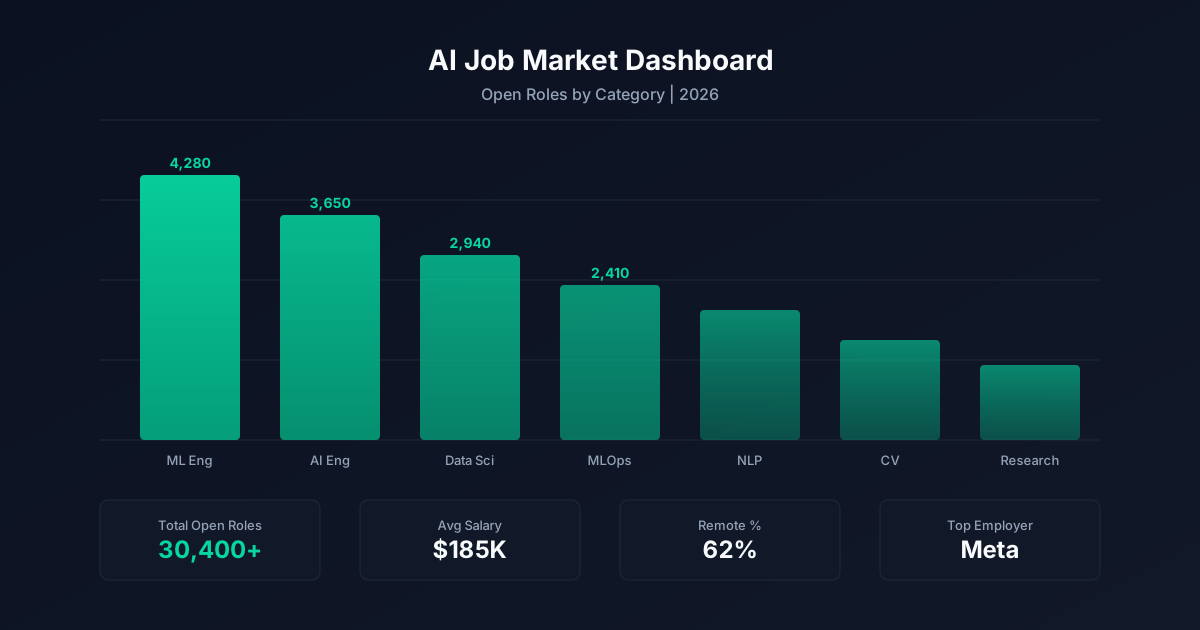
The AI job market spans 3,708 open positions across 16 role categories. The largest categories by volume: AI/ML Engineer (2,605), Data Scientist (310), AI Software Engineer (259). These three account for the majority of open positions, though smaller categories often have higher per-role compensation because of specialized skill requirements.
The seniority mix tells a story about where AI teams are in their maturity. Entry-level roles (102) are outnumbered by mid-level (1,705) and senior (1,469) positions, reflecting that most companies are past the 'build a team from scratch' phase and need experienced engineers who can ship production systems. Leadership roles (Director, VP, C-Level) total 432 positions, representing the bottleneck between technical execution and organizational strategy.
Remote work availability sits at 14% of all AI roles (508 positions), with 3,180 requiring on-site or hybrid attendance. The remote share has stabilized after the post-pandemic correction. Senior and specialized roles (Research Scientist, ML Architect) are more likely to be remote-eligible than entry-level positions, partly because experienced hires have more negotiating power and partly because these roles require less hands-on mentorship.
AI compensation is structured in clear tiers. The market median sits at $217,500. Top-quartile roles start at $272,100, and the 90th percentile reaches $325,000. These figures include base salary with disclosed compensation. Total compensation (including equity, bonuses, and sign-on) runs 20-40% higher at companies that offer those components.
Category matters for compensation. AI Safety roles lead at $300,000 median, while Prompt Engineer roles sit at $140,000. The spread between highest and lowest-paying categories reflects the premium on specialized technical skills versus broader analytical roles.
The most in-demand skills across all AI postings: Python (1,890 postings), Aws (1,103 postings), Azure (877 postings), Rag (855 postings), Gcp (631 postings), Prompt Engineering (560 postings), Pytorch (545 postings), Claude (498 postings). Python dominates, appearing in the vast majority of role descriptions regardless of category. Cloud platform experience (AWS, GCP, Azure) is the second most common requirement. The newer entrants to the top skills list (RAG, vector databases, LLM APIs) reflect the shift from traditional ML toward generative AI applications.
Frequently Asked Questions
Get Weekly AI Career Intelligence
Salary data, skills demand, and market signals from 16,000+ AI job postings. Every Monday.