
Interested in this Data Scientist role at ConnectiveRx?
Apply Now →Skills & Technologies
About This Role
Overview:
Being on medication is tough enough. We want to make getting it the easy part. Getting prescriptions to patients has become increasingly complex. When things get messy along the prescription journey, pharmaceutical manufacturers rely on us to untangle the process and create a clear path—allowing patients to build trusting relationships with their medication brands.
We’re not only committed to taking the pain out of the prescription process, but we’re also devoted to bringing the brightest minds together under one roof. We bring together diverse voices—engineers, pharmacists, customer service veterans, developers, program strategists and more—all with one vision. Each perspective and experience makes ConnectiveRx better than the sum of its parts.
The Data Scientist position will perform data analysis as well as research, design, simulate, and prototype new algorithmic product designs based on business needs, with a focus on optimizing the speed, impact and cost of financial assistance delivered to the patient while minimizing risk of fraud or abuse of benefits.
Responsibilities:
- Develop and deploy supervised machine learning models, which utilize data provided by the company’s call centers and live programs, and unsupervised machine learning models on Amazon Web Services;
- Gain insight into and munge data sets for use in modeling;
- Collaborate with customers to brainstorm hypotheses, leverage unique data sets, conduct trial analyses and share results at key milestones;
- Align design efforts with ConnectiveRx services, data sets and value proposition;
- Visualize data in the Looker dashboard, tuning ML Models; and
- Work closely with different clients for identifying anomaly patterns in data.
- Hybrid Work Schedule.
Standard company benefits.
*
Qualifications:
- Master’s degree or foreign equivalent in Business Analytics and Project Management, Information Technology, or a closely related field;
- Experience with/demonstrated knowledge of developing robust AI tool for automated detection and overseeing its design, implementation, and refinement to ensure reliable performance;
- Experience with/demonstrated knowledge of processing and managing image data for model training and evaluation;
- Experience with/demonstrated knowledge of Machine Learning;
- Experience with/demonstrated knowledge of integrating AI models with a website using REST API in Python, designing and implementing API endpoints to facilitate seamless interaction between the model and the web\-based application;
- Experience with/demonstrated knowledge of designing scalable APIs and structured data models to support efficient data processing and inference requests;
- Experience with/demonstrated knowledge of leveraging Google Cloud for scalable model deployment, enabling efficient storage, computation, and inference in a cloud\-based environment;
- Experience with/demonstrated knowledge of collaborating within an Agile Scrum framework, contributing to iterative development, cross\-functional collaboration, and continuous improvement of the AI\-driven solution;
- Experience with/demonstrated knowledge of improving data accessibility for non\-technical staff;
- Experience with/demonstrated knowledge of creating SQL scripts for simplified querying;
- Experience with/demonstrated knowledge of data cleaning;
- Experience with/demonstrated knowledge of implementing JDBC for seamless database connectivity and integrated REST\-based services within the Serenity framework;
- Experience with/demonstrated knowledge of maintaining version control using Git;
- Experience with/demonstrated knowledge of developing and executing automated integration testing in Serenity;
- Experience with/demonstrated knowledge of validating application functionality and ensuring software reliability;
- Experience with/demonstrated knowledge of designing data models, sequence diagrams, and class diagrams; and
- Experience with/demonstrated knowledge of using: REST\-based services, automated integration tests, Cloud/VM infrastructure and technologies, NoSQL databases, and tuning ML Models.
- Employer will accept any level of experience, knowledge, or proficiency in the skills listed. Knowledge may be gained through course work/research projects/work experience.
Compensation \& Benefits: This position offers opportunities for a bonus (or commissions), with total compensation varying based on factors such as location, relevant skills, experience, and capabilities.
Employees at ConnectiveRx can access comprehensive benefits, including medical, dental, vision, life, and disability insurance. The company regularly reviews and updates its health, welfare, and fringe benefit policies to ensure competitive offerings. Employees may also participate in the company’s 401(k) plan, with employer contributions where applicable.
Time\-Off \& Holidays: ConnectiveRx provides a flexible paid time off (PTO) policy for exempt employees, covering sick days, personal days, and vacations. PTO is determined based on an employee’s first year of service. Employees also receive eight standard company holidays and three floating holidays annually, with prorations applied in the first year.
The company remains committed to providing competitive benefits and reserves the right to modify employee offerings, including PTO, STO, and holiday policies, in accordance with applicable laws and regulations.
Posted Salary Range: USD $138,135\.00 \- USD $145,000\.00 /Yr.
Salary Context
This $138K-$145K range is below the median for Data Scientist roles in our dataset (median: $155K across 226 roles with salary data).
View full Data Scientist salary data →Role Details
About This Role
Data Scientists extract insights and build predictive models from data. In the AI era, many roles now include LLM-powered analytics, automated reporting, and integration with generative AI tools. The role has evolved from 'the person who runs SQL queries' to 'the person who builds AI-powered data products.'
Modern data science roles fall into two camps: analytics-focused (insights, dashboards, experimentation) and ML-focused (building predictive models, recommendation systems, NLP features). The best data scientists can operate in both modes. The AI shift means that even analytics-focused roles now involve building automated insight pipelines using LLMs, going well beyond one-off reports.
Across the 3,708 AI roles we're tracking, Data Scientist positions make up 8% of the market. At ConnectiveRx, this role fits into their broader AI and engineering organization.
Data Scientist roles remain in high demand, though the definition keeps shifting. Companies increasingly want candidates who can bridge traditional statistics with modern ML and LLM capabilities. The 'pure insights' data scientist role is consolidating into analytics engineering, while the 'build models' data scientist role is merging with ML engineering.
What the Work Looks Like
A typical week includes: analyzing experiment results for a product feature launch, building a predictive model for customer churn, creating an automated reporting pipeline using LLM-powered summarization, presenting insights to stakeholders, and cleaning data (always cleaning data). The ratio of analysis to engineering varies by company, but expect both.
Data Scientist roles remain in high demand, though the definition keeps shifting. Companies increasingly want candidates who can bridge traditional statistics with modern ML and LLM capabilities. The 'pure insights' data scientist role is consolidating into analytics engineering, while the 'build models' data scientist role is merging with ML engineering.
Skills Required
Python, SQL, and statistical modeling are the foundation. Increasingly, roles want experience with LLMs for data analysis, automated insight generation, and building AI-powered data products. Familiarity with cloud data platforms (Snowflake, BigQuery, Databricks) and ML frameworks (scikit-learn, PyTorch) covers most job requirements.
Experimentation design and causal inference are underrated skills that separate strong candidates. Companies care about whether their product changes cause improvements, and can distinguish causation from correlation. A/B testing methodology, Bayesian statistics, and the ability to communicate uncertainty to non-technical stakeholders are high-value skills.
Good postings specify the data stack, the types of problems you'll work on, and the team structure. Look for companies that differentiate between analytics and ML data science. Vague 'data scientist' postings that list every skill under the sun usually mean the company doesn't know what they need.
Compensation Benchmarks
Data Scientist roles pay a median of $192,890 based on 463 positions with disclosed compensation. Mid-level AI roles across all categories have a median of $200,000. This role's midpoint ($141K) sits 27% below the category median. Disclosed range: $138K to $145K.
Across all AI roles, the market median is $217,500. Top-quartile compensation starts at $272,100. The 90th percentile reaches $325,000. For comparison, the highest-paying categories include AI Safety ($300,000) and Research Engineer ($280,000). By seniority level: Entry: $120,000; Mid: $200,000; Senior: $230,000; Director: $272,150; VP: $250,000.
ConnectiveRx AI Hiring
ConnectiveRx has 2 open AI roles right now. They're hiring across Data Scientist, AI/ML Engineer. Based in Whippany, NJ, US. Compensation range: $145K - $218K.
Location Context
Across all AI roles, 14% (508 positions) offer remote work, while 3,180 require on-site attendance. Top AI hiring metros: New York (1,045 roles, $220,000 median); San Francisco (810 roles, $277,088 median); Los Angeles (397 roles, $215,000 median).
Career Path
Common paths into Data Scientist roles include Data Analyst, Statistician, Quantitative Researcher.
From here, career progression typically leads toward Senior Data Scientist, ML Engineer, AI Product Manager.
Start with statistics and SQL. Build a real analysis project on public data that demonstrates insight generation alongside model building. The market values data scientists who can communicate findings clearly to business stakeholders. If you want to move toward ML engineering, invest in software engineering fundamentals and production deployment skills.
What to Expect in Interviews
Interviews combine statistics, coding, and business acumen. SQL is almost always tested, often with complex joins and window functions. Expect a case study round where you're given a business problem and asked to design an analysis plan. Coding rounds focus on pandas, statistical modeling, and visualization. The strongest differentiator is how well you communicate insights to non-technical stakeholders during presentation rounds.
When evaluating opportunities: Good postings specify the data stack, the types of problems you'll work on, and the team structure. Look for companies that differentiate between analytics and ML data science. Vague 'data scientist' postings that list every skill under the sun usually mean the company doesn't know what they need.
AI Hiring Overview
The AI job market has 3,708 open positions tracked in our dataset. By seniority: 102 entry-level, 1,705 mid-level, 1,469 senior, and 432 leadership roles (Director, VP, C-Level). Remote roles make up 14% of the market (508 positions). The remaining 3,180 roles require on-site or hybrid attendance.
The market median for AI roles is $217,500. Top-quartile compensation starts at $272,100. The 90th percentile reaches $325,000. Highest-paying categories: AI Safety ($300,000 median, 21 roles); Research Engineer ($280,000 median, 147 roles); AI Architect ($254,798 median, 67 roles).
Data Scientist roles remain in high demand, though the definition keeps shifting. Companies increasingly want candidates who can bridge traditional statistics with modern ML and LLM capabilities. The 'pure insights' data scientist role is consolidating into analytics engineering, while the 'build models' data scientist role is merging with ML engineering.
The AI Job Market Today
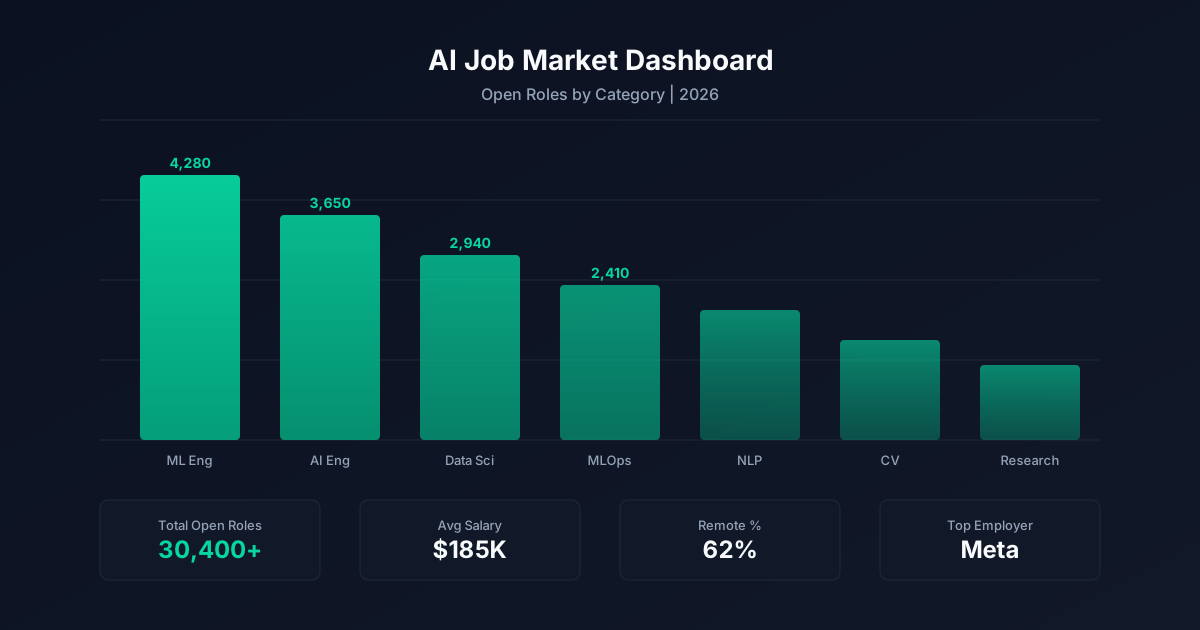
The AI job market spans 3,708 open positions across 16 role categories. The largest categories by volume: AI/ML Engineer (2,605), Data Scientist (310), AI Software Engineer (259). These three account for the majority of open positions, though smaller categories often have higher per-role compensation because of specialized skill requirements.
The seniority mix tells a story about where AI teams are in their maturity. Entry-level roles (102) are outnumbered by mid-level (1,705) and senior (1,469) positions, reflecting that most companies are past the 'build a team from scratch' phase and need experienced engineers who can ship production systems. Leadership roles (Director, VP, C-Level) total 432 positions, representing the bottleneck between technical execution and organizational strategy.
Remote work availability sits at 14% of all AI roles (508 positions), with 3,180 requiring on-site or hybrid attendance. The remote share has stabilized after the post-pandemic correction. Senior and specialized roles (Research Scientist, ML Architect) are more likely to be remote-eligible than entry-level positions, partly because experienced hires have more negotiating power and partly because these roles require less hands-on mentorship.
AI compensation is structured in clear tiers. The market median sits at $217,500. Top-quartile roles start at $272,100, and the 90th percentile reaches $325,000. These figures include base salary with disclosed compensation. Total compensation (including equity, bonuses, and sign-on) runs 20-40% higher at companies that offer those components.
Category matters for compensation. AI Safety roles lead at $300,000 median, while Prompt Engineer roles sit at $140,000. The spread between highest and lowest-paying categories reflects the premium on specialized technical skills versus broader analytical roles.
The most in-demand skills across all AI postings: Python (1,890 postings), Aws (1,103 postings), Azure (877 postings), Rag (855 postings), Gcp (631 postings), Prompt Engineering (560 postings), Pytorch (545 postings), Claude (498 postings). Python dominates, appearing in the vast majority of role descriptions regardless of category. Cloud platform experience (AWS, GCP, Azure) is the second most common requirement. The newer entrants to the top skills list (RAG, vector databases, LLM APIs) reflect the shift from traditional ML toward generative AI applications.
Frequently Asked Questions
Get Weekly AI Career Intelligence
Salary data, skills demand, and market signals from 16,000+ AI job postings. Every Monday.