
Interested in this Data Scientist role at Innodata?
Apply Now →Skills & Technologies
About This Role
Innodata (Nasdaq: INOD) is a global data engineering company. We believe that data and Artificial Intelligence (AI) are inextricably linked. Our mission is to enable the responsible advancement of artificial intelligence by providing the data, evaluation frameworks, and human expertise required to build AI systems that can be trusted at scale. We provide a range of transferable solutions, platforms, and services for Generative AI / AI builders and adopters. In every relationship, we honor our 36\+ year legacy delivering the highest quality data and outstanding outcomes for our customers.
Scope of the Role:
Healthcare is one of the highest\-stakes domains for generative AI. Clinical accuracy, patient safety, regulatory compliance, health equity, auditability, and workflow fit are the bar for shipping anything real. Innodata partners with foundation model labs, medical AI startups, payers, providers, pharma, and digital health companies building LLMs, multimodal systems, and AI agents for healthcare and life sciences.
As an Applied Data Scientist, Health AI Evaluation \& Datasets, you own the design, measurement quality, and clinical validity of datasets used to train, fine\-tune, and evaluate health\-domain models. You bring clinical or biomedical fluency and data science rigor: you can read a clinical guideline, payer policy, medical literature artifact, or patient communication workflow; translate it into a measurable dataset and evaluation plan; and defend the methodology to sophisticated clinical, data science, and ML stakeholders.
You will work in a tight pod with a Technical Solutions Architect, Applied Research Scientist, AI/ML Research Engineer, and Language Data Scientists. Your role is to make sure the data, rubrics, review workflows, and measurement evidence are clinically realistic, statistically defensible, compliant, and useful for evaluation and post\-training.
What You'll Own:
- Translate customer goals — such as improving differential diagnosis, evaluating a clinical note summarizer, testing a RAG\-based medical literature assistant, or creating preference data for patient\-facing chatbots — into dataset specifications, taxonomies, rubrics, sampling plans, and acceptance criteria.
- Make multimodal health AI a core focus: design training and evaluation datasets across clinical text, medical images, waveforms, structured EHR data, claims, trial data, medical literature, patient communications, payer policies, drug information, and other clinical artifacts, as well as use cases such as clinical reasoning, medical QA, note summarization, medical coding, patient communication, utilization management, and literature synthesis.
- Design evaluations for retrieval\-augmented and source\-grounded health AI systems, including evidence citation, faithfulness, contraindication handling, guideline adherence, source freshness, and failure modes caused by incomplete, conflicting, or stale context.
- Define sampling strategies, label schemas, inter\-annotator agreement targets, adjudication workflows, SME review patterns, and quality thresholds in partnership with Language Data Scientists, clinicians, biomedical experts, and quality teams.
- Build statistical and ML checks that make healthcare datasets trustworthy: stratified sampling across specialties and patient subgroups, bias and representation analysis, leakage detection, distribution shift checks, uncertainty estimates, reliability metrics, and subgroup performance analysis.
- Partner with Applied Research Scientists and AI/ML Research Engineers to instrument datasets into evaluation and post\-training pipelines, including rubric\-grounded LLM\-as\-judge prompts, regression suites, model comparison workflows, experiment tracking, and model\-improvement feedback loops.
- Evaluate health AI behavior beyond surface accuracy: calibration, hallucination on safety\-critical content, refusal appropriateness, robustness under ambiguity, equity across patient subgroups, and safe handoff in agentic or workflow\-integrated systems. Reason concretely about clinical workflow fit: where outputs enter care delivery, what evidence a clinician or reviewer would need to trust them, when uncertainty must be surfaced, and how patient\-facing, clinician\-facing, payer, pharma, and operational use cases differ in risk.
- Own data quality from source intake through delivery, including de\-identified clinical text, medical literature, synthetic cases, structured records, client policies, and knowledge bases, with attention to PHI/PII handling, provenance, audit trails, versioning, and compliance documentation.
- Stay current on the health AI landscape — regulatory developments such as FDA guidance on AI/ML\-enabled medical devices and EU AI Act health provisions, benchmark releases such as MedQA, MedMCQA, and HealthBench, and emerging clinical evaluation methodology.
- Support customer discovery and proposal work by scoping dataset programs, sizing annotation and SME review effort, identifying regulatory or data\-access constraints, and explaining methodology choices to client clinical and ML leadership.
- Contribute to Innodata internal IP: reusable health\-domain taxonomies, evaluation rubrics, golden datasets, clinical review playbooks, dataset quality checks, and methodology templates.
You'll Thrive in This Role If You Have:
- 5\+ years of data science experience, including at least 2\+ years with healthcare, clinical, biomedical, payer, provider, pharma, life sciences, or comparable regulated health data.
- Working knowledge of healthcare data and standards: EHR structure, clinical documentation conventions, ICD\-10, CPT, SNOMED CT, LOINC, RxNorm, and at least passing familiarity with FHIR, HL7, or equivalent interoperability concepts.
- Hands\-on experience designing ML datasets, not just consuming them: writing annotation guidelines, sizing cohorts, setting quality thresholds, designing QA checks, and shipping data that downstream teams can train or evaluate on.
- Familiarity with LLM\-based health AI workflows, including prompt design, rubric\-based evaluation, retrieval\-augmented generation, LLM\-as\-judge methods, model comparison, and the limitations of automated evaluation in clinical contexts.
- Strong Python and SQL; comfort with pandas, scikit\-learn, statsmodels or equivalent tools; and working familiarity with modern LLM tooling such as Hugging Face, evaluation frameworks, prompt development tools, or model APIs.
- Statistical literacy across sampling design, bias and fairness analysis, inter\-annotator agreement metrics (Cohen or Fleiss kappa, Krippendorff alpha), confidence intervals, significance testing where appropriate, error analysis, and the ability to push back when a number is being over\-interpreted.
- Solid grasp of healthcare privacy, compliance, and governance: HIPAA, de\-identification standards (Safe Harbor and Expert Determination), practical mechanics of working with PHI safely, auditability, access control, and documentation fit for high\-stakes or regulated AI programs.
- Ability to work credibly with clinicians, biomedical SMEs, research scientists, engineers, technical solutions teams, annotators, and customer stakeholders.
- A bias toward clinical realism: you would rather build a smaller dataset that reflects what clinicians, reviewers, patients, or care teams actually see than a larger dataset that looks impressive on paper but fails in practice.
- Degree in a relevant field such as biostatistics, epidemiology, computational biology, health informatics, computer science with a health focus, statistics, a clinical degree with quantitative training, or equivalent demonstrated experience.
- Clinical credentials are not required, but candidates must be able to work credibly with clinicians, biomedical SMEs, and health AI customers; candidates with MD, RN, PharmD, MPH, PhD, or health informatics backgrounds are especially encouraged.
*The expected salary range for this position is $150,000 – $175,000 USD per year, based on experience, skills, and qualifications.*
*Please be aware of recruitment scams involving individuals or organizations falsely claiming to represent employers. Innodata will never ask for payment, banking details, or sensitive personal information during the application process. To learn more on how to recognize job scams, please visit the Federal Trade Commission's guide at* https://consumer.ftc.gov/articles/job\-scams.
*If you believe you've been targeted by a recruitment scam, please report it to Innodata at* verifyjoboffer@innodata.com *and consider reporting it to the FTC at* ReportFraud.ftc.gov*.*
Salary Context
This $150K-$175K range is above the median for Data Scientist roles in our dataset (median: $155K across 226 roles with salary data).
View full Data Scientist salary data →Role Details
About This Role
Data Scientists extract insights and build predictive models from data. In the AI era, many roles now include LLM-powered analytics, automated reporting, and integration with generative AI tools. The role has evolved from 'the person who runs SQL queries' to 'the person who builds AI-powered data products.'
Modern data science roles fall into two camps: analytics-focused (insights, dashboards, experimentation) and ML-focused (building predictive models, recommendation systems, NLP features). The best data scientists can operate in both modes. The AI shift means that even analytics-focused roles now involve building automated insight pipelines using LLMs, going well beyond one-off reports.
Across the 3,708 AI roles we're tracking, Data Scientist positions make up 8% of the market. At Innodata, this role fits into their broader AI and engineering organization.
Data Scientist roles remain in high demand, though the definition keeps shifting. Companies increasingly want candidates who can bridge traditional statistics with modern ML and LLM capabilities. The 'pure insights' data scientist role is consolidating into analytics engineering, while the 'build models' data scientist role is merging with ML engineering.
What the Work Looks Like
A typical week includes: analyzing experiment results for a product feature launch, building a predictive model for customer churn, creating an automated reporting pipeline using LLM-powered summarization, presenting insights to stakeholders, and cleaning data (always cleaning data). The ratio of analysis to engineering varies by company, but expect both.
Data Scientist roles remain in high demand, though the definition keeps shifting. Companies increasingly want candidates who can bridge traditional statistics with modern ML and LLM capabilities. The 'pure insights' data scientist role is consolidating into analytics engineering, while the 'build models' data scientist role is merging with ML engineering.
Skills Required
Python, SQL, and statistical modeling are the foundation. Increasingly, roles want experience with LLMs for data analysis, automated insight generation, and building AI-powered data products. Familiarity with cloud data platforms (Snowflake, BigQuery, Databricks) and ML frameworks (scikit-learn, PyTorch) covers most job requirements.
Experimentation design and causal inference are underrated skills that separate strong candidates. Companies care about whether their product changes cause improvements, and can distinguish causation from correlation. A/B testing methodology, Bayesian statistics, and the ability to communicate uncertainty to non-technical stakeholders are high-value skills.
Good postings specify the data stack, the types of problems you'll work on, and the team structure. Look for companies that differentiate between analytics and ML data science. Vague 'data scientist' postings that list every skill under the sun usually mean the company doesn't know what they need.
Compensation Benchmarks
Data Scientist roles pay a median of $192,890 based on 463 positions with disclosed compensation. Mid-level AI roles across all categories have a median of $200,000. This role's midpoint ($162K) sits 16% below the category median. Disclosed range: $150K to $175K.
Across all AI roles, the market median is $217,500. Top-quartile compensation starts at $272,100. The 90th percentile reaches $325,000. For comparison, the highest-paying categories include AI Safety ($300,000) and Research Engineer ($280,000). By seniority level: Entry: $120,000; Mid: $200,000; Senior: $230,000; Director: $272,150; VP: $250,000.
Innodata AI Hiring
Innodata has 3 open AI roles right now. They're hiring across AI/ML Engineer, Data Scientist. Positions span Tysons Corner, VA, US, Ridgefield Park, NJ, US. Compensation range: $166K - $175K.
Location Context
Across all AI roles, 14% (508 positions) offer remote work, while 3,180 require on-site attendance. Top AI hiring metros: New York (1,045 roles, $220,000 median); San Francisco (810 roles, $277,088 median); Los Angeles (397 roles, $215,000 median).
Career Path
Common paths into Data Scientist roles include Data Analyst, Statistician, Quantitative Researcher.
From here, career progression typically leads toward Senior Data Scientist, ML Engineer, AI Product Manager.
Start with statistics and SQL. Build a real analysis project on public data that demonstrates insight generation alongside model building. The market values data scientists who can communicate findings clearly to business stakeholders. If you want to move toward ML engineering, invest in software engineering fundamentals and production deployment skills.
What to Expect in Interviews
Interviews combine statistics, coding, and business acumen. SQL is almost always tested, often with complex joins and window functions. Expect a case study round where you're given a business problem and asked to design an analysis plan. Coding rounds focus on pandas, statistical modeling, and visualization. The strongest differentiator is how well you communicate insights to non-technical stakeholders during presentation rounds.
When evaluating opportunities: Good postings specify the data stack, the types of problems you'll work on, and the team structure. Look for companies that differentiate between analytics and ML data science. Vague 'data scientist' postings that list every skill under the sun usually mean the company doesn't know what they need.
AI Hiring Overview
The AI job market has 3,708 open positions tracked in our dataset. By seniority: 102 entry-level, 1,705 mid-level, 1,469 senior, and 432 leadership roles (Director, VP, C-Level). Remote roles make up 14% of the market (508 positions). The remaining 3,180 roles require on-site or hybrid attendance.
The market median for AI roles is $217,500. Top-quartile compensation starts at $272,100. The 90th percentile reaches $325,000. Highest-paying categories: AI Safety ($300,000 median, 21 roles); Research Engineer ($280,000 median, 147 roles); AI Architect ($254,798 median, 67 roles).
Data Scientist roles remain in high demand, though the definition keeps shifting. Companies increasingly want candidates who can bridge traditional statistics with modern ML and LLM capabilities. The 'pure insights' data scientist role is consolidating into analytics engineering, while the 'build models' data scientist role is merging with ML engineering.
The AI Job Market Today
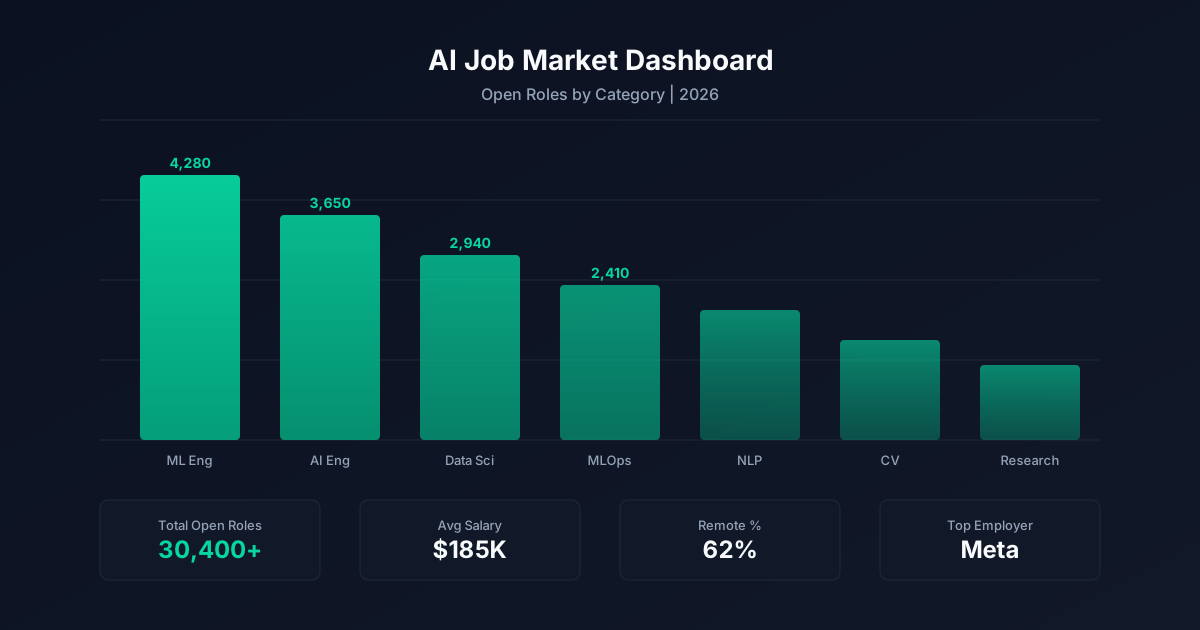
The AI job market spans 3,708 open positions across 16 role categories. The largest categories by volume: AI/ML Engineer (2,605), Data Scientist (310), AI Software Engineer (259). These three account for the majority of open positions, though smaller categories often have higher per-role compensation because of specialized skill requirements.
The seniority mix tells a story about where AI teams are in their maturity. Entry-level roles (102) are outnumbered by mid-level (1,705) and senior (1,469) positions, reflecting that most companies are past the 'build a team from scratch' phase and need experienced engineers who can ship production systems. Leadership roles (Director, VP, C-Level) total 432 positions, representing the bottleneck between technical execution and organizational strategy.
Remote work availability sits at 14% of all AI roles (508 positions), with 3,180 requiring on-site or hybrid attendance. The remote share has stabilized after the post-pandemic correction. Senior and specialized roles (Research Scientist, ML Architect) are more likely to be remote-eligible than entry-level positions, partly because experienced hires have more negotiating power and partly because these roles require less hands-on mentorship.
AI compensation is structured in clear tiers. The market median sits at $217,500. Top-quartile roles start at $272,100, and the 90th percentile reaches $325,000. These figures include base salary with disclosed compensation. Total compensation (including equity, bonuses, and sign-on) runs 20-40% higher at companies that offer those components.
Category matters for compensation. AI Safety roles lead at $300,000 median, while Prompt Engineer roles sit at $140,000. The spread between highest and lowest-paying categories reflects the premium on specialized technical skills versus broader analytical roles.
The most in-demand skills across all AI postings: Python (1,890 postings), Aws (1,103 postings), Azure (877 postings), Rag (855 postings), Gcp (631 postings), Prompt Engineering (560 postings), Pytorch (545 postings), Claude (498 postings). Python dominates, appearing in the vast majority of role descriptions regardless of category. Cloud platform experience (AWS, GCP, Azure) is the second most common requirement. The newer entrants to the top skills list (RAG, vector databases, LLM APIs) reflect the shift from traditional ML toward generative AI applications.
Frequently Asked Questions
Get Weekly AI Career Intelligence
Salary data, skills demand, and market signals from 16,000+ AI job postings. Every Monday.