
Interested in this Data Scientist role at Karius?
Apply Now →Skills & Technologies
About This Role
About Karius
Karius is a life science, venture\-backed clinical metagenomics company, focused on elevating patient care through microbial insights. We are committed to advancing diagnostic science and technology to optimize the diagnosis and treatment of infectious diseases. Through the use of genomics and AI, we are driven to improve the diagnostic landscape for infectious diseases. Karius delivers unprecedented diagnostic insight detecting microbial cell\-free DNA circulating in the body to assist physicians to make rapid treatment decisions.
Position Summary
The Sr. Clinical Data Scientist will serve as the primary data architect for Karius’s large\-scale commercial real\-world evidence registry. This role sits at the intersection of clinical research and health informatics, responsible for designing and operationalizing EHR data extraction pipelines across participating health systems, translating clinical research requirements into structured data specifications, and transforming heterogeneous real\-world data into analysis\-ready datasets that support biostatistics and clinical development. The ideal candidate is equally comfortable negotiating data specifications with a site’s Epic Clarity team and working alongside biostatisticians to structure complex longitudinal datasets.
Why Should You Join Us?
Karius aims to conquer infectious diseases through innovations around genomic sequencing and machine learning. The company’s platform is already delivering unprecedented insights into the microbial landscape, providing clinicians with a comprehensive test capable of identifying more than a thousand pathogens directly from blood, and helping industry accelerate the development of therapeutic solutions. The products Karius offers today are some of the most advanced solutions available to physicians who aim to deliver better care to many otherwise ineffectively treated patients. Our tests are the result of some incredible work done by our scientists, statisticians, engineers, and physicians, all driven by the same mission. You, as part of the Karius team, will be able to see how directly your work has a life\-changing impact on people, and at scale.
Reports to: Director, Clinical Statistics and Data Management
Location: Redwood City, CA or Remote
Primary Responsibilities
- Own EHR data extraction specifications for the AXIS registry, including data element definitions, data dictionaries, field mappings, and site\-specific translation logic across heterogeneous EHR environments.
- Serve as the primary technical liaison to site informatics and IT teams, translating clinical research data requirements into executable data queries and extraction protocols; primary experience with Epic Clarity and/or Caboodle required.
- Design and validate data extraction pipelines that ingest structured EHR data (diagnoses, medications, labs, procedures, utilization) from multiple health systems into a harmonized, analysis\-ready format.
- Perform data quality assessment, anomaly detection, and cross\-site consistency validation; implement processes to identify and resolve data integrity issues with sites.
- Partner closely with the biostatistics team to deliver clean, structured, well\-documented datasets; support data preparation, variable derivation, and dataset specifications for statistical analysis plans.
- Collaborate with clinical operations on site onboarding for clinical site data integration, including support for data governance agreements, BAAs, and technical feasibility assessments.
- Build and maintain the registry data model, data lineage documentation, and codebook to ensure reproducibility and audit\-readiness.
- Apply working knowledge of real\-world data standards (OMOP CDM, HL7 FHIR, SNOMED, ICD\-10, LOINC) to support data harmonization across sites with diverse EHR configurations.
- Support seamless integration between EHR data, the registry EDC, and Karius' standardized internal clinical database.
- Support broader clinical research data analytics across programs, including integrating datasets from multiple sources, building analysis\-ready analytic files, and data visualization to support clinical development and biostatistics teams
- Contribute to the design of data collection strategies for future real\-world evidence studies and registry expansions.
What’s Fun About the Job?
Karius is operating at the edge of what is now known to be possible in diagnostics. With that, comes a wave of new and incredible challenges and opportunities. To deliver on that value, you will be tapping into some of the most advanced technologies, architecting and innovating where the current solutions simply don't suffice. You will get to see how much your work really matters.
Travel: Up to 20%.
Physical Requirements
Subject to extended periods of sitting and/or standing, vision to monitor and moderate noise levels. Work is generally performed in an office, lab or clinical environment.
Position Requirements
- Bachelor’s degree in Health Informatics, Biomedical Informatics, Data Science, Computer Science, Biostatistics, Epidemiology, Public Health, or a related quantitative or clinical field with 5\-6\+ years of relevant experience; a master’s degree or MPH with 3\-4\+ years of relevant experience; or a Ph.D. with 1\-2\+ years of relevant experience.
- Minimum 4\+ years of hands\-on experience with Epic Clarity and/or other systems; ability to write and optimize SQL queries against large clinical data warehouses.
- Demonstrated experience designing or executing EHR data extractions for research or registry studies, including direct engagement with health system informatics or IT teams.
- Proficiency in Python and/or R for data transformation, cleaning, and quality assessment at scale.
- Familiarity with real\-world data standards including OMOP CDM, CDISC, HL7 FHIR, SNOMED CT, ICD\-10, and LOINC.
- Experience supporting biostatistics or data science teams with dataset preparation, variable derivation, and analysis\-ready data delivery.
- Ability to communicate technical data concepts clearly to non\-technical clinical site staff, research coordinators, and clinical operations colleagues.
- Experience with large, multi\-site, longitudinal real\-world datasets strongly preferred.
- Knowledge of clinical trial data management principles and ICH\-GCP a plus.
Personal Qualifications
- Strong technical aptitude, including the ability to write and interpret complex SQL queries.
- Ability to translate technical clinical data requirements into clear, practical guidance for non\-technical stakeholders.
- Strong attention to detail and comfort working with complex data sharing specifications.
- Intellectual curiosity and sound judgment when evaluating clinical data, workflows, and downstream implications.
- Ability to move fluidly between hands\-on technical work and stakeholder\-facing communication.
- Collaborative communication style, with the ability to partner effectively with site coordinators, clinical teams, and cross\-functional stakeholders.
Disclaimer
The above job description is intended to describe the general nature and level of work being performed by individuals assigned to this position. It is not intended to be an exhaustive list of all duties, responsibilities, and skills required. Responsibilities and duties may change or be adjusted to meet the needs of the company, and additional duties may be assigned as necessary. The job description is subject to change at any time at the discretion of Karius.
Equal Opportunity Employer
At Karius, we value a diverse and inclusive workplace and provide equal employment opportunities for all applicants and employees and are committed to honor and invest in the full diversity of people, in our hiring, recruiting and development of employees across the Company. All qualified applicants for employment are encouraged to apply and will be considered without regard to an individual’s race, color, sex, gender identity and gender expression (including transgender individuals who are transitioning, have transitioned, or are perceived to be transitioning to the gender with which they identify), religion, age, national origin or ancestry, citizenship, physical or mental disability, medical condition, family care status, marital status, domestic partner status, sexual orientation, genetic information, military or veteran status, or any other basis protected by federal, state or local laws. If you are unable to submit your application due to a disability, please contact us at recruiting@kariusdx.com and we will accommodate qualified individuals with disabilities.
Salary Context
This $133K-$200K range is above the median for Data Scientist roles in our dataset (median: $155K across 226 roles with salary data).
View full Data Scientist salary data →Role Details
About This Role
Data Scientists extract insights and build predictive models from data. In the AI era, many roles now include LLM-powered analytics, automated reporting, and integration with generative AI tools. The role has evolved from 'the person who runs SQL queries' to 'the person who builds AI-powered data products.'
Modern data science roles fall into two camps: analytics-focused (insights, dashboards, experimentation) and ML-focused (building predictive models, recommendation systems, NLP features). The best data scientists can operate in both modes. The AI shift means that even analytics-focused roles now involve building automated insight pipelines using LLMs, going well beyond one-off reports.
Across the 3,708 AI roles we're tracking, Data Scientist positions make up 8% of the market. At Karius, this role fits into their broader AI and engineering organization.
Data Scientist roles remain in high demand, though the definition keeps shifting. Companies increasingly want candidates who can bridge traditional statistics with modern ML and LLM capabilities. The 'pure insights' data scientist role is consolidating into analytics engineering, while the 'build models' data scientist role is merging with ML engineering.
What the Work Looks Like
A typical week includes: analyzing experiment results for a product feature launch, building a predictive model for customer churn, creating an automated reporting pipeline using LLM-powered summarization, presenting insights to stakeholders, and cleaning data (always cleaning data). The ratio of analysis to engineering varies by company, but expect both.
Data Scientist roles remain in high demand, though the definition keeps shifting. Companies increasingly want candidates who can bridge traditional statistics with modern ML and LLM capabilities. The 'pure insights' data scientist role is consolidating into analytics engineering, while the 'build models' data scientist role is merging with ML engineering.
Skills Required
Python, SQL, and statistical modeling are the foundation. Increasingly, roles want experience with LLMs for data analysis, automated insight generation, and building AI-powered data products. Familiarity with cloud data platforms (Snowflake, BigQuery, Databricks) and ML frameworks (scikit-learn, PyTorch) covers most job requirements.
Experimentation design and causal inference are underrated skills that separate strong candidates. Companies care about whether their product changes cause improvements, and can distinguish causation from correlation. A/B testing methodology, Bayesian statistics, and the ability to communicate uncertainty to non-technical stakeholders are high-value skills.
Good postings specify the data stack, the types of problems you'll work on, and the team structure. Look for companies that differentiate between analytics and ML data science. Vague 'data scientist' postings that list every skill under the sun usually mean the company doesn't know what they need.
Compensation Benchmarks
Data Scientist roles pay a median of $192,890 based on 463 positions with disclosed compensation. Senior-level AI roles across all categories have a median of $230,000. This role's midpoint ($167K) sits 13% below the category median. Disclosed range: $133K to $200K.
Across all AI roles, the market median is $217,500. Top-quartile compensation starts at $272,100. The 90th percentile reaches $325,000. For comparison, the highest-paying categories include AI Safety ($300,000) and Research Engineer ($280,000). By seniority level: Entry: $120,000; Mid: $200,000; Senior: $230,000; Director: $272,150; VP: $250,000.
Karius AI Hiring
Karius has 1 open AI role right now. They're hiring across Data Scientist. Based in Redwood City, CA, US. Compensation range: $200K - $200K.
Location Context
Across all AI roles, 14% (508 positions) offer remote work, while 3,180 require on-site attendance. Top AI hiring metros: New York (1,045 roles, $220,000 median); San Francisco (810 roles, $277,088 median); Los Angeles (397 roles, $215,000 median).
Career Path
Common paths into Data Scientist roles include Data Analyst, Statistician, Quantitative Researcher.
From here, career progression typically leads toward Senior Data Scientist, ML Engineer, AI Product Manager.
Start with statistics and SQL. Build a real analysis project on public data that demonstrates insight generation alongside model building. The market values data scientists who can communicate findings clearly to business stakeholders. If you want to move toward ML engineering, invest in software engineering fundamentals and production deployment skills.
What to Expect in Interviews
Interviews combine statistics, coding, and business acumen. SQL is almost always tested, often with complex joins and window functions. Expect a case study round where you're given a business problem and asked to design an analysis plan. Coding rounds focus on pandas, statistical modeling, and visualization. The strongest differentiator is how well you communicate insights to non-technical stakeholders during presentation rounds.
When evaluating opportunities: Good postings specify the data stack, the types of problems you'll work on, and the team structure. Look for companies that differentiate between analytics and ML data science. Vague 'data scientist' postings that list every skill under the sun usually mean the company doesn't know what they need.
AI Hiring Overview
The AI job market has 3,708 open positions tracked in our dataset. By seniority: 102 entry-level, 1,705 mid-level, 1,469 senior, and 432 leadership roles (Director, VP, C-Level). Remote roles make up 14% of the market (508 positions). The remaining 3,180 roles require on-site or hybrid attendance.
The market median for AI roles is $217,500. Top-quartile compensation starts at $272,100. The 90th percentile reaches $325,000. Highest-paying categories: AI Safety ($300,000 median, 21 roles); Research Engineer ($280,000 median, 147 roles); AI Architect ($254,798 median, 67 roles).
Data Scientist roles remain in high demand, though the definition keeps shifting. Companies increasingly want candidates who can bridge traditional statistics with modern ML and LLM capabilities. The 'pure insights' data scientist role is consolidating into analytics engineering, while the 'build models' data scientist role is merging with ML engineering.
The AI Job Market Today
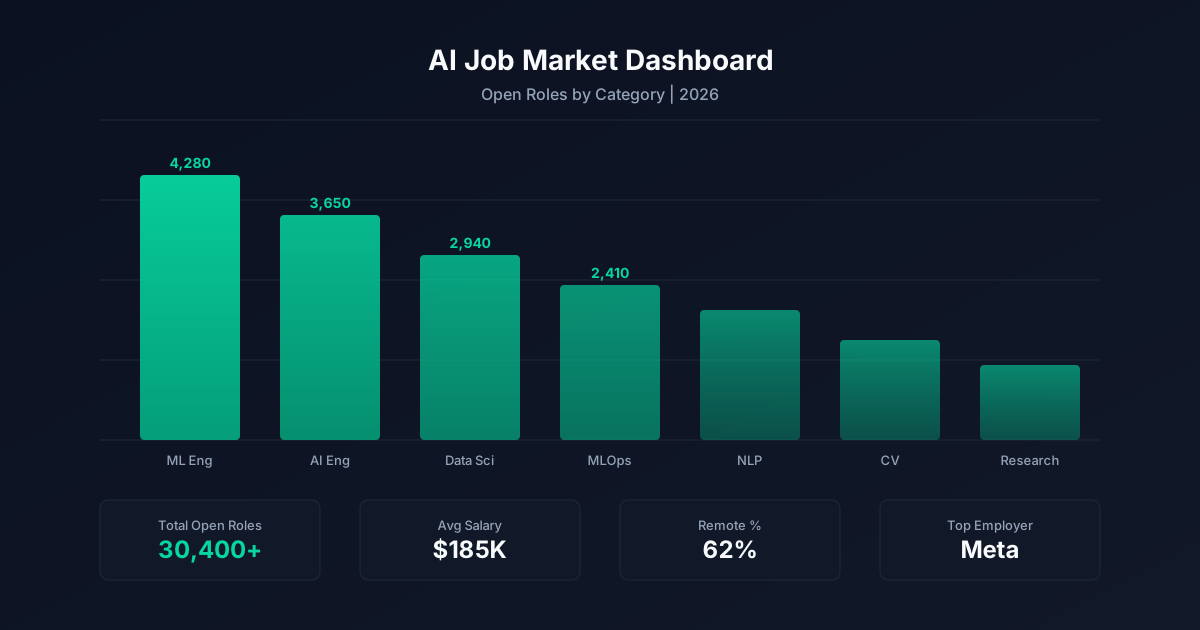
The AI job market spans 3,708 open positions across 16 role categories. The largest categories by volume: AI/ML Engineer (2,605), Data Scientist (310), AI Software Engineer (259). These three account for the majority of open positions, though smaller categories often have higher per-role compensation because of specialized skill requirements.
The seniority mix tells a story about where AI teams are in their maturity. Entry-level roles (102) are outnumbered by mid-level (1,705) and senior (1,469) positions, reflecting that most companies are past the 'build a team from scratch' phase and need experienced engineers who can ship production systems. Leadership roles (Director, VP, C-Level) total 432 positions, representing the bottleneck between technical execution and organizational strategy.
Remote work availability sits at 14% of all AI roles (508 positions), with 3,180 requiring on-site or hybrid attendance. The remote share has stabilized after the post-pandemic correction. Senior and specialized roles (Research Scientist, ML Architect) are more likely to be remote-eligible than entry-level positions, partly because experienced hires have more negotiating power and partly because these roles require less hands-on mentorship.
AI compensation is structured in clear tiers. The market median sits at $217,500. Top-quartile roles start at $272,100, and the 90th percentile reaches $325,000. These figures include base salary with disclosed compensation. Total compensation (including equity, bonuses, and sign-on) runs 20-40% higher at companies that offer those components.
Category matters for compensation. AI Safety roles lead at $300,000 median, while Prompt Engineer roles sit at $140,000. The spread between highest and lowest-paying categories reflects the premium on specialized technical skills versus broader analytical roles.
The most in-demand skills across all AI postings: Python (1,890 postings), Aws (1,103 postings), Azure (877 postings), Rag (855 postings), Gcp (631 postings), Prompt Engineering (560 postings), Pytorch (545 postings), Claude (498 postings). Python dominates, appearing in the vast majority of role descriptions regardless of category. Cloud platform experience (AWS, GCP, Azure) is the second most common requirement. The newer entrants to the top skills list (RAG, vector databases, LLM APIs) reflect the shift from traditional ML toward generative AI applications.
Frequently Asked Questions
Get Weekly AI Career Intelligence
Salary data, skills demand, and market signals from 16,000+ AI job postings. Every Monday.