
Interested in this Data Scientist role at Lynker?
Apply Now →About This Role
Overview:
Lynker Corporation is seeking a Senior Fisheries Data Scientist – Salmon Survival, Migration, and Mark\-Recapture Modeling to support NOAA Fisheries’ Northwest Fisheries Science Center (NWFSC), Fish Ecology Division, by providing statistical analysis to inform management decisions. This proposed contract role will support analysis of migrating salmon in river systems, with emphasis on survival and migration patterns through hydropower systems and across salmon life cycles. Hiring for this position will be contingent on contract award. Lynker will be operating under its FLOAT joint venture, a NOAA ProTech Fisheries 2\.0 prime contract holder.\*
The NWFSC Fish Ecology Division conducts scientific research on marine and anadromous species in the Pacific Northwest and California to support fisheries management, ESA\-related needs, and sustainable fisheries decision making. This role supports NOAA’s need for high\-level statistical modeling, quantitative analysis, and ecological knowledge to produce products that inform management decisions affecting Pacific salmon, including dam operations, habitat changes, and harvest limits.
Responsibilities:
Duties of the Fisheries Data Scientist will include the following:
----------------------------------------------------------------------
- Provide statistical analysis to inform management decisions.
- Statistically analyze spatial and temporal variability in processes experienced by migrating salmon in river systems.
- Analyze survival and migration patterns through hydropower systems and across salmon life cycles.
- Analyze and generate relationships between fish responses, including density, growth, survival, and migration rate, and stressors such as environmental or ecological conditions, habitat metrics, and management actions.
- Develop novel probabilistic mathematical and simulation models representing unique and complex ecological and behavioral processes using modern statistical methods.
- Provide statistical support for other researchers during study design and analysis.
- Organize and curate ecological datasets relevant to mark\-recapture modeling needs.
- Document and share reproducible research workflows and analytical protocols to support scientific transparency and peer collaboration.
- Publish reports and scientific papers, and present results at regional and national meetings and scientific conferences, as needed.
- Assist with field collection of fish and environmental data in freshwater, estuarine, and nearshore marine environments of the West Coast region, as needed.
- Support analysis products archived in accessible and organized formats, including final data and models shared through public scientific repositories or interactive research dashboards.
- Prepare written status reports and other ad hoc communications, as needed.
Qualifications:
The Fisheries Data Scientist selected should have the following:
--------------------------------------------------------------------
- PhD degree from an accredited college or university with a major in a field of study related to the requirements of the task order, with emphasis in statistics, mathematics, fisheries, ecology, or the natural sciences.
- Strong quantitative background with a solid foundation and extensive coursework in statistics and probability.
- Ten or more years of experience related to the task order, including familiarity with the species and habitats managed by NOAA Fisheries in the West Coast region.
- Advanced degree in a related field may be substituted for two years, MS, or four years, PhD, of experience.
- Excellent verbal and written communication skills.
- Experience writing reports and publishing peer\-reviewed articles.
- Strong quantitative skills, including extensive experience in statistical modeling and data analysis.
- Extensive experience conducting analyses and coding in R.
- Experience with programs Stan and JAGS.
- Experience with open science concepts.
- Strong computational skills, including the ability to manipulate large environmental datasets within a command\-line environment, such as Linux/shell scripting, to support statistical workflows.
- Familiarity interpreting or interfacing with C or C\+\+ code within a scientific modeling context.
- Familiarity with common software including Google Suite and Microsoft Office.
- Ability to manage workload, stay organized, and produce high\-quality work products efficiently.
- Ability to work both independently and on interdisciplinary teams.
- Valid driver’s license, maintained during the period of performance.
The Ideal Fisheries Data Scientist will have the following:
---------------------------------------------------------------
- Knowledge and experience in Bayesian statistics and mark\-recapture methods.
Work Environment
--------------------
Work will be conducted on\-site at the Northwest Fisheries Science Center in Seattle, WA, or at one of its associated field stations in WA or OR, or at a mutually agreed upon location. Work may be performed at other than the government facility on a limited basis and in coordination with the COR and Project Lead. Part\-time telework is authorized with a formal telework agreement between the Contractor and employee, subject to Office of the Chief Information Officer IT security requirements.
The role may include assistance with field collection of fish and environmental data in freshwater, estuarine, and nearshore marine environments of the West Coast region, as needed, and may involve riding in vehicles and/or boats. Travel is anticipated and authorized for this task order and must be approved by the Contractor in coordination with the COR before travel occurs. Overtime is not anticipated and must be coordinated and authorized before being worked.
This project is considered low risk, and Contractor staff must be suited for public trust classification. Background investigations are required for all Contractor staff proposed for this project and must be cleared prior to beginning performance. Effective January 1, 2026, vendors and visitors must present REAL ID\-compliant identification, or an acceptable alternative government\-issued photo identification, to enter applicable DOC/NOAA facilities.
About Lynker
Lynker is a growing, employee owned business, specializing in professional, scientific and technical services. Our continually expanding team combines scientific expertise with mature, results\-driven processes and tools to achieve technically sound, cost effective solutions in hydrology/water sciences, geospatial analysis, information technology, resource management, conservation, and management and business process improvement.
We focus on putting the right people in the right place to be effective. And having the right people is critical for success. Our streamlined organization enables and empowers our talented professionals to tackle our customers' scientific and technical priorities – creatively and effectively.
Lynker offers a team\-oriented work environment, and the opportunity to work in a culture of exceptionally skilled professionals who embrace sound science and creative solutions. Lynker's benefits include the following:* Comprehensive healthcare for the employee at no monthly cost
- Healthcare benefit covers medical, prescription drug, dental, and vision
- Personal Time Off (PTO) Policy plus paid holidays
- Highly competitive compensation plan regularly calibrated against industry and location benchmarks
- 401(k) retirement plan with company\-matching
- Employee Stock Ownership Plan (ESOP) – we're all company owners!
- Flexible spending accounts
- Employee assistance program (EAP)
- Short\- and long\-term disability insurance
- Life and accident insurance
- Tuition assistance/Training/Workforce improvement reimbursement per year
- Spot bonuses for exceptional performance
- Annual Employee Recognition Awards with bonuses
- Employee Referral Program
- Free centralized, self\-directed Learning Management System to learn at your own pace
- Personalized career growth plans for every employee
Lynker is an E\-Verify employer. Lynker is an equal opportunity employer and makes all employment decisions based on merit, qualifications, and business needs. We do not discriminate on the basis of race, color, religion, sex (including pregnancy, sexual orientation, or gender identity), national origin, age, disability, genetic information, marital status, veteran status, or any other legally protected status under federal, state, or local laws.* This position is advertised through our joint venture, FISH and Lynker Ocean Alliance Team (FLOAT), a partnership between Lynker and Fisheries Immersed Sciences Hawaii (FISH) serving the NOAA ProTech Fisheries 2\.0 IDIQ contracting vehicle.
- ️ Fraud Alert: Recruitment Scam Warning: Lynker has been made aware of fraudulent individuals posing as Lynker recruiters and offering fake job opportunities. All legitimate Lynker job postings are listed on our official careers page. Communication from Lynker recruiters will come from an official @lynker.com email address.
Salary Context
This $90K-$125K range is in the lower quartile for Data Scientist roles in our dataset (median: $155K across 226 roles with salary data).
View full Data Scientist salary data →Role Details
About This Role
Data Scientists extract insights and build predictive models from data. In the AI era, many roles now include LLM-powered analytics, automated reporting, and integration with generative AI tools. The role has evolved from 'the person who runs SQL queries' to 'the person who builds AI-powered data products.'
Modern data science roles fall into two camps: analytics-focused (insights, dashboards, experimentation) and ML-focused (building predictive models, recommendation systems, NLP features). The best data scientists can operate in both modes. The AI shift means that even analytics-focused roles now involve building automated insight pipelines using LLMs, going well beyond one-off reports.
Across the 3,708 AI roles we're tracking, Data Scientist positions make up 8% of the market. At Lynker, this role fits into their broader AI and engineering organization.
Data Scientist roles remain in high demand, though the definition keeps shifting. Companies increasingly want candidates who can bridge traditional statistics with modern ML and LLM capabilities. The 'pure insights' data scientist role is consolidating into analytics engineering, while the 'build models' data scientist role is merging with ML engineering.
What the Work Looks Like
A typical week includes: analyzing experiment results for a product feature launch, building a predictive model for customer churn, creating an automated reporting pipeline using LLM-powered summarization, presenting insights to stakeholders, and cleaning data (always cleaning data). The ratio of analysis to engineering varies by company, but expect both.
Data Scientist roles remain in high demand, though the definition keeps shifting. Companies increasingly want candidates who can bridge traditional statistics with modern ML and LLM capabilities. The 'pure insights' data scientist role is consolidating into analytics engineering, while the 'build models' data scientist role is merging with ML engineering.
Skills in Demand for This Role
Python, SQL, and statistical modeling are the foundation. Increasingly, roles want experience with LLMs for data analysis, automated insight generation, and building AI-powered data products. Familiarity with cloud data platforms (Snowflake, BigQuery, Databricks) and ML frameworks (scikit-learn, PyTorch) covers most job requirements.
Experimentation design and causal inference are underrated skills that separate strong candidates. Companies care about whether their product changes cause improvements, and can distinguish causation from correlation. A/B testing methodology, Bayesian statistics, and the ability to communicate uncertainty to non-technical stakeholders are high-value skills.
Good postings specify the data stack, the types of problems you'll work on, and the team structure. Look for companies that differentiate between analytics and ML data science. Vague 'data scientist' postings that list every skill under the sun usually mean the company doesn't know what they need.
Compensation Benchmarks
Data Scientist roles pay a median of $192,890 based on 463 positions with disclosed compensation. Senior-level AI roles across all categories have a median of $230,000. This role's midpoint ($107K) sits 44% below the category median. Disclosed range: $90K to $125K.
Across all AI roles, the market median is $217,500. Top-quartile compensation starts at $272,100. The 90th percentile reaches $325,000. For comparison, the highest-paying categories include AI Safety ($300,000) and Research Engineer ($280,000). By seniority level: Entry: $120,000; Mid: $200,000; Senior: $230,000; Director: $272,150; VP: $250,000.
Lynker AI Hiring
Lynker has 2 open AI roles right now. They're hiring across AI/ML Engineer, Data Scientist. Positions span College Park, MD, US, Seattle, WA, US. Compensation range: $125K - $195K.
Location Context
AI roles in Seattle pay a median of $236,900 across 267 tracked positions. That's 9% above the national median.
Career Path
Common paths into Data Scientist roles include Data Analyst, Statistician, Quantitative Researcher.
From here, career progression typically leads toward Senior Data Scientist, ML Engineer, AI Product Manager.
Start with statistics and SQL. Build a real analysis project on public data that demonstrates insight generation alongside model building. The market values data scientists who can communicate findings clearly to business stakeholders. If you want to move toward ML engineering, invest in software engineering fundamentals and production deployment skills.
What to Expect in Interviews
Interviews combine statistics, coding, and business acumen. SQL is almost always tested, often with complex joins and window functions. Expect a case study round where you're given a business problem and asked to design an analysis plan. Coding rounds focus on pandas, statistical modeling, and visualization. The strongest differentiator is how well you communicate insights to non-technical stakeholders during presentation rounds.
When evaluating opportunities: Good postings specify the data stack, the types of problems you'll work on, and the team structure. Look for companies that differentiate between analytics and ML data science. Vague 'data scientist' postings that list every skill under the sun usually mean the company doesn't know what they need.
AI Hiring Overview
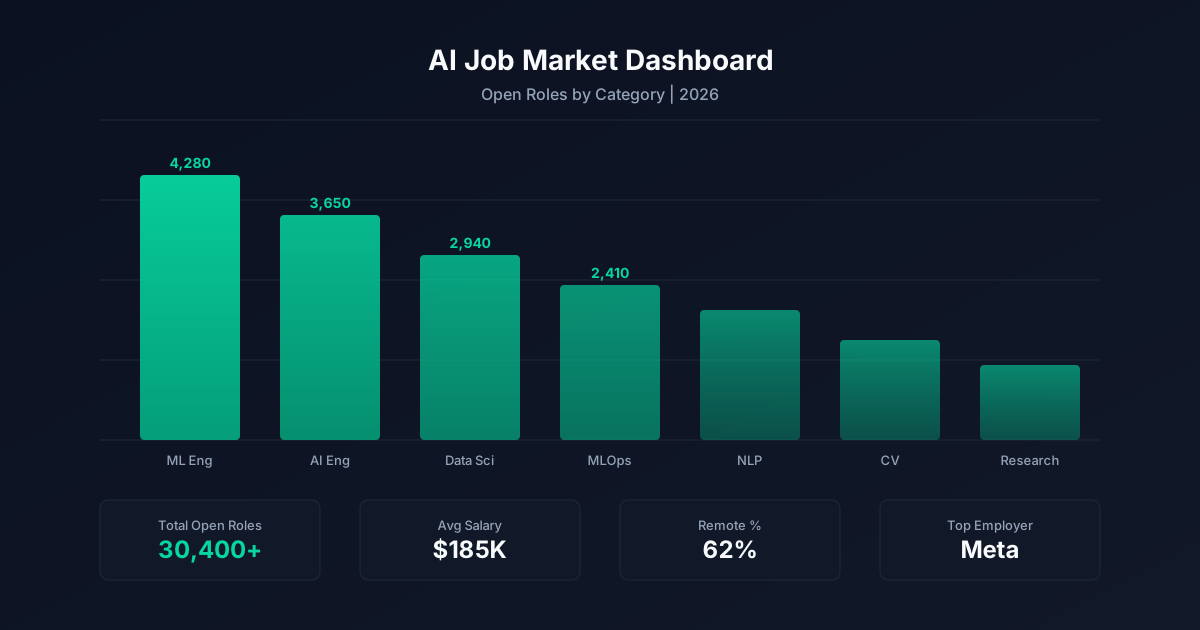
The AI job market has 3,708 open positions tracked in our dataset. By seniority: 102 entry-level, 1,705 mid-level, 1,469 senior, and 432 leadership roles (Director, VP, C-Level). Remote roles make up 14% of the market (508 positions). The remaining 3,180 roles require on-site or hybrid attendance.
The market median for AI roles is $217,500. Top-quartile compensation starts at $272,100. The 90th percentile reaches $325,000. Highest-paying categories: AI Safety ($300,000 median, 21 roles); Research Engineer ($280,000 median, 147 roles); AI Architect ($254,798 median, 67 roles).
Data Scientist roles remain in high demand, though the definition keeps shifting. Companies increasingly want candidates who can bridge traditional statistics with modern ML and LLM capabilities. The 'pure insights' data scientist role is consolidating into analytics engineering, while the 'build models' data scientist role is merging with ML engineering.
The AI Job Market Today
The AI job market spans 3,708 open positions across 16 role categories. The largest categories by volume: AI/ML Engineer (2,605), Data Scientist (310), AI Software Engineer (259). These three account for the majority of open positions, though smaller categories often have higher per-role compensation because of specialized skill requirements.
The seniority mix tells a story about where AI teams are in their maturity. Entry-level roles (102) are outnumbered by mid-level (1,705) and senior (1,469) positions, reflecting that most companies are past the 'build a team from scratch' phase and need experienced engineers who can ship production systems. Leadership roles (Director, VP, C-Level) total 432 positions, representing the bottleneck between technical execution and organizational strategy.
Remote work availability sits at 14% of all AI roles (508 positions), with 3,180 requiring on-site or hybrid attendance. The remote share has stabilized after the post-pandemic correction. Senior and specialized roles (Research Scientist, ML Architect) are more likely to be remote-eligible than entry-level positions, partly because experienced hires have more negotiating power and partly because these roles require less hands-on mentorship.
AI compensation is structured in clear tiers. The market median sits at $217,500. Top-quartile roles start at $272,100, and the 90th percentile reaches $325,000. These figures include base salary with disclosed compensation. Total compensation (including equity, bonuses, and sign-on) runs 20-40% higher at companies that offer those components.
Category matters for compensation. AI Safety roles lead at $300,000 median, while Prompt Engineer roles sit at $140,000. The spread between highest and lowest-paying categories reflects the premium on specialized technical skills versus broader analytical roles.
The most in-demand skills across all AI postings: Python (1,890 postings), Aws (1,103 postings), Azure (877 postings), Rag (855 postings), Gcp (631 postings), Prompt Engineering (560 postings), Pytorch (545 postings), Claude (498 postings). Python dominates, appearing in the vast majority of role descriptions regardless of category. Cloud platform experience (AWS, GCP, Azure) is the second most common requirement. The newer entrants to the top skills list (RAG, vector databases, LLM APIs) reflect the shift from traditional ML toward generative AI applications.
Frequently Asked Questions
Get Weekly AI Career Intelligence
Salary data, skills demand, and market signals from 16,000+ AI job postings. Every Monday.