
Interested in this Data Scientist role at Oracle?
Apply Now →Skills & Technologies
About This Role
The Principal Data Scientist will conduct structured market research, analyze campaign and customer data, identify emerging trends, and provide evidence\-based recommendations that enhance audience segmentation, messaging, channel strategy, and overall program effectiveness. Working closely with Marketing, Sales, Business Development, Operations, and Analytics teams, this individual will help ensure marketing investments are aligned with business objectives and deliver measurable results.
The ideal candidate combines strong analytical skills with marketing acumen and can effectively translate complex data into meaningful business recommendations for stakeholders and leadership.
Key Responsibilities
- Conduct quantitative and qualitative market research to identify customer trends, competitive insights, and emerging market opportunities.
- Analyze campaign, pipeline, customer, and engagement data to identify opportunities for optimization and growth.
- Develop actionable recommendations that improve marketing strategy, audience targeting, messaging, and campaign performance.
- Partner with Demand Generation, Sales, Product Marketing, and Business Development teams to support integrated marketing initiatives.
- Build dashboards, scorecards, and reports that measure campaign effectiveness and key performance indicators (KPIs).
- Monitor marketing program performance and provide ongoing optimization recommendations based on data and business insights.
- Support audience segmentation, account prioritization, and customer journey analysis to improve campaign effectiveness.
- Assist in forecasting program outcomes and measuring return on marketing investment (ROMI).
- Present findings and recommendations to cross\-functional stakeholders and leadership in a clear, concise, and compelling manner.
- Maintain data quality and ensure reporting accuracy across marketing systems and platforms.
- Identify opportunities to automate reporting, streamline analysis, and improve marketing measurement processes.
- Stay informed on industry trends, competitive intelligence, and best practices in B2B marketing and demand generation.
- Bachelor's degree in Marketing, Business, Economics, Data Analytics, Statistics, Communications, or a related field.
- 7\+ years of experience in marketing analytics, marketing operations, demand generation, business intelligence, or a related analytical marketing role.
- Experience analyzing large datasets to identify trends and generate actionable business insights.
- Strong analytical, critical thinking, and problem\-solving skills.
- Advanced proficiency with Microsoft Excel and PowerPoint.
- Experience creating dashboards, reports, and executive presentations.
- Excellent written and verbal communication skills with the ability to present data to both technical and non\-technical audiences.
- Strong organizational skills with the ability to manage multiple projects simultaneously.
Preferred Qualifications
- Experience supporting enterprise B2B marketing organizations.
- Knowledge of demand generation, account\-based marketing (ABM), customer segmentation, and campaign performance analysis.
- Experience with CRM and marketing automation platforms such as Oracle Eloqua, Salesforce, Marketo, or HubSpot.
- Experience with business intelligence and visualization tools such as Oracle Analytics, Power BI, Tableau, or Looker.
- Familiarity with SQL or other data querying tools is a plus.
- Understanding of marketing attribution models, pipeline analysis, and return on marketing investment (ROMI).
- Experience using AI\-driven marketing analytics or predictive modeling tools is desirable.
Role Details
About This Role
Data Scientists extract insights and build predictive models from data. In the AI era, many roles now include LLM-powered analytics, automated reporting, and integration with generative AI tools. The role has evolved from 'the person who runs SQL queries' to 'the person who builds AI-powered data products.'
Modern data science roles fall into two camps: analytics-focused (insights, dashboards, experimentation) and ML-focused (building predictive models, recommendation systems, NLP features). The best data scientists can operate in both modes. The AI shift means that even analytics-focused roles now involve building automated insight pipelines using LLMs, going well beyond one-off reports.
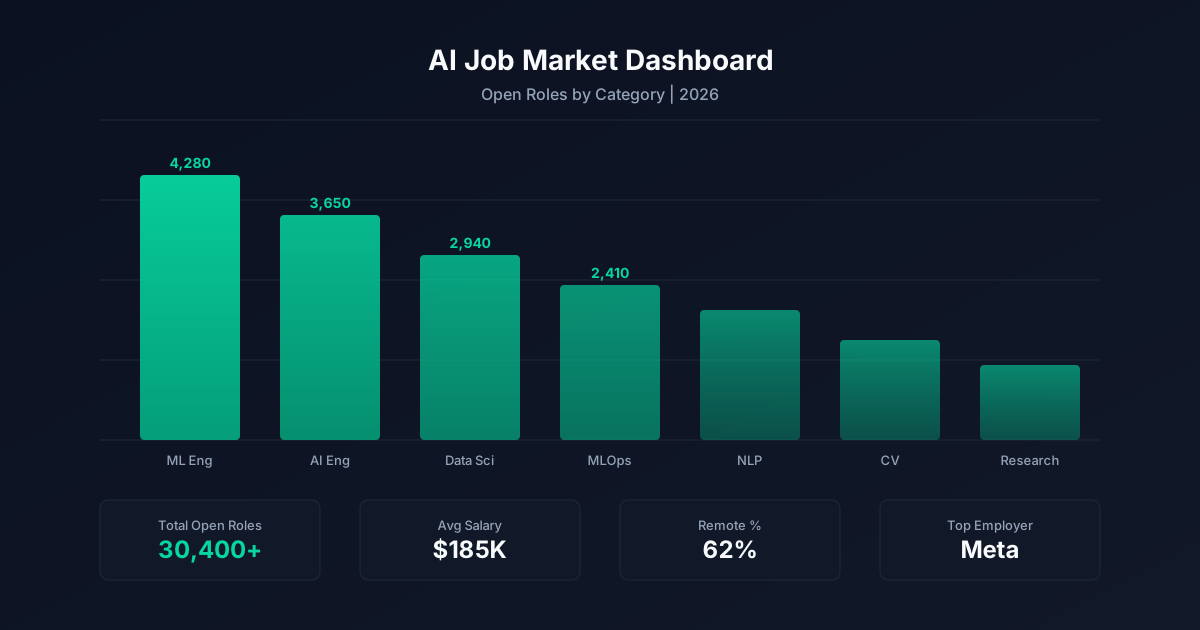
Across the 3,708 AI roles we're tracking, Data Scientist positions make up 8% of the market. At Oracle, this role fits into their broader AI and engineering organization.
Data Scientist roles remain in high demand, though the definition keeps shifting. Companies increasingly want candidates who can bridge traditional statistics with modern ML and LLM capabilities. The 'pure insights' data scientist role is consolidating into analytics engineering, while the 'build models' data scientist role is merging with ML engineering.
What the Work Looks Like
A typical week includes: analyzing experiment results for a product feature launch, building a predictive model for customer churn, creating an automated reporting pipeline using LLM-powered summarization, presenting insights to stakeholders, and cleaning data (always cleaning data). The ratio of analysis to engineering varies by company, but expect both.
Data Scientist roles remain in high demand, though the definition keeps shifting. Companies increasingly want candidates who can bridge traditional statistics with modern ML and LLM capabilities. The 'pure insights' data scientist role is consolidating into analytics engineering, while the 'build models' data scientist role is merging with ML engineering.
Skills Required
Python, SQL, and statistical modeling are the foundation. Increasingly, roles want experience with LLMs for data analysis, automated insight generation, and building AI-powered data products. Familiarity with cloud data platforms (Snowflake, BigQuery, Databricks) and ML frameworks (scikit-learn, PyTorch) covers most job requirements.
Experimentation design and causal inference are underrated skills that separate strong candidates. Companies care about whether their product changes cause improvements, and can distinguish causation from correlation. A/B testing methodology, Bayesian statistics, and the ability to communicate uncertainty to non-technical stakeholders are high-value skills.
Good postings specify the data stack, the types of problems you'll work on, and the team structure. Look for companies that differentiate between analytics and ML data science. Vague 'data scientist' postings that list every skill under the sun usually mean the company doesn't know what they need.
Compensation Benchmarks
Data Scientist roles pay a median of $192,890 based on 463 positions with disclosed compensation. Senior-level AI roles across all categories have a median of $230,000.
Across all AI roles, the market median is $217,500. Top-quartile compensation starts at $272,100. The 90th percentile reaches $325,000. For comparison, the highest-paying categories include AI Safety ($300,000) and Research Engineer ($280,000). By seniority level: Entry: $120,000; Mid: $200,000; Senior: $230,000; Director: $272,150; VP: $250,000.
Oracle AI Hiring
Oracle has 15 open AI roles right now. They're hiring across AI Agent Developer, AI Engineering Manager, AI/ML Engineer, AI Software Engineer. Positions span US, Seattle, WA, US, Redwood City, CA, US.
Location Context
AI roles in Austin pay a median of $214,343 across 87 tracked positions.
Career Path
Common paths into Data Scientist roles include Data Analyst, Statistician, Quantitative Researcher.
From here, career progression typically leads toward Senior Data Scientist, ML Engineer, AI Product Manager.
Start with statistics and SQL. Build a real analysis project on public data that demonstrates insight generation alongside model building. The market values data scientists who can communicate findings clearly to business stakeholders. If you want to move toward ML engineering, invest in software engineering fundamentals and production deployment skills.
What to Expect in Interviews
Interviews combine statistics, coding, and business acumen. SQL is almost always tested, often with complex joins and window functions. Expect a case study round where you're given a business problem and asked to design an analysis plan. Coding rounds focus on pandas, statistical modeling, and visualization. The strongest differentiator is how well you communicate insights to non-technical stakeholders during presentation rounds.
When evaluating opportunities: Good postings specify the data stack, the types of problems you'll work on, and the team structure. Look for companies that differentiate between analytics and ML data science. Vague 'data scientist' postings that list every skill under the sun usually mean the company doesn't know what they need.
AI Hiring Overview
The AI job market has 3,708 open positions tracked in our dataset. By seniority: 102 entry-level, 1,705 mid-level, 1,469 senior, and 432 leadership roles (Director, VP, C-Level). Remote roles make up 14% of the market (508 positions). The remaining 3,180 roles require on-site or hybrid attendance.
The market median for AI roles is $217,500. Top-quartile compensation starts at $272,100. The 90th percentile reaches $325,000. Highest-paying categories: AI Safety ($300,000 median, 21 roles); Research Engineer ($280,000 median, 147 roles); AI Architect ($254,798 median, 67 roles).
Data Scientist roles remain in high demand, though the definition keeps shifting. Companies increasingly want candidates who can bridge traditional statistics with modern ML and LLM capabilities. The 'pure insights' data scientist role is consolidating into analytics engineering, while the 'build models' data scientist role is merging with ML engineering.
The AI Job Market Today
The AI job market spans 3,708 open positions across 16 role categories. The largest categories by volume: AI/ML Engineer (2,605), Data Scientist (310), AI Software Engineer (259). These three account for the majority of open positions, though smaller categories often have higher per-role compensation because of specialized skill requirements.
The seniority mix tells a story about where AI teams are in their maturity. Entry-level roles (102) are outnumbered by mid-level (1,705) and senior (1,469) positions, reflecting that most companies are past the 'build a team from scratch' phase and need experienced engineers who can ship production systems. Leadership roles (Director, VP, C-Level) total 432 positions, representing the bottleneck between technical execution and organizational strategy.
Remote work availability sits at 14% of all AI roles (508 positions), with 3,180 requiring on-site or hybrid attendance. The remote share has stabilized after the post-pandemic correction. Senior and specialized roles (Research Scientist, ML Architect) are more likely to be remote-eligible than entry-level positions, partly because experienced hires have more negotiating power and partly because these roles require less hands-on mentorship.
AI compensation is structured in clear tiers. The market median sits at $217,500. Top-quartile roles start at $272,100, and the 90th percentile reaches $325,000. These figures include base salary with disclosed compensation. Total compensation (including equity, bonuses, and sign-on) runs 20-40% higher at companies that offer those components.
Category matters for compensation. AI Safety roles lead at $300,000 median, while Prompt Engineer roles sit at $140,000. The spread between highest and lowest-paying categories reflects the premium on specialized technical skills versus broader analytical roles.
The most in-demand skills across all AI postings: Python (1,890 postings), Aws (1,103 postings), Azure (877 postings), Rag (855 postings), Gcp (631 postings), Prompt Engineering (560 postings), Pytorch (545 postings), Claude (498 postings). Python dominates, appearing in the vast majority of role descriptions regardless of category. Cloud platform experience (AWS, GCP, Azure) is the second most common requirement. The newer entrants to the top skills list (RAG, vector databases, LLM APIs) reflect the shift from traditional ML toward generative AI applications.
Frequently Asked Questions
Get Weekly AI Career Intelligence
Salary data, skills demand, and market signals from 16,000+ AI job postings. Every Monday.