
Interested in this Data Scientist role at Spectrum?
Apply Now →Skills & Technologies
About This Role
This role requires the ability to work lawfully in the U.S. without employment\-based immigration sponsorship, now or in the future.
Are you ready to harness your analytical and programming skills to create data\-driven solutions that tackle Spectrum’s business challenges? You could be a fit for our Data Scientist IV role. In this position you will work alongside network engineers, software engineers, and operations teams to develop data\-driven approaches to identify customer impairments, improve network reliability, and support automation of issue detection. You will utilize analytical, statistical, and programming skills to clean, aggregate, and analyze large data sets and interpret results. How You’ll Make an Impact* Partner on the design and implementation of statistical data quality procedures for existing and new data sources
- Research and apply knowledge of existing and emerging data science principles, theories, and techniques to inform business decisions
- Develop Machine Learning (ML) models to detect and predict network issues affecting customer experience
- Assist in designing and optimizing feature engineering to extract meaningful insights from raw telemetry data
- Assist in the creation and presentation of data insights and recommendations to key stakeholders
- Plan, manage, and monitor independent projects from concept through implementation
- Apply appropriate level of data maintenance, data quality control and validation of code, tools, and models as directed
Working Conditions* Office environment
What You’ll Bring to Spectrum
Required Qualifications
Education* Bachelor's degree in computer science, statistics, operations research and/or equivalent combination of education and experience
Experience* 2\+ years data science experience
- 2\+ years programming experience
Skills* Ability to perform in\-depth and independent research and analysis with oversight
- Demonstrated ability to apply core data science principles and machine learning techniques (regression, decision trees, clustering, time series, SVMs, neural networks) with minimal guidance
- Ability to use a data science toolkit such as Python, R, SQL; and have demonstrated learning of additional languages or advanced functionality
- Demonstrated ability to work in cloud\-based infrastructures
- Experience with big data tools such as Spark and Hive
- Strong background in mathematical and statistical concepts and demonstrated ability to apply techniques with oversight
- Command of development of data tools and models, scripting, analysis and ETL, and ability to synthesize complex code with guidance.
- Knowledge of statistical techniques and machine learning algorithms
- Demonstrated practical ability to determine where to invest time, synthesize actionable findings across diverse assignments, and present findings to audiences with diverse agendas and varying levels of technical expertise
\#LI\-KB2
BDA328 2026\-74894 2026
Here, our employees don’t just have jobs, they're building careers. That’s why we offer a comprehensive pay and benefits package that rewards employees for their contributions to our success, supporting all aspects of their well\-being at every stage of life.
A qualified applicant’s criminal history, if any, will be considered in a manner consistent with applicable laws, including local ordinances.
This job posting will remain open until 2026\-07\-26 04:38 PM (UTC) and will be extended if necessary.
The base pay for this position generally is between $88,200\.00 and $156,600\.00. The actual compensation offered will carefully consider a wide range of factors, including your skills, qualifications, experience, and location. We comply with local wage minimums and also, certain positions are eligible for additional forms of other incentive\-based compensation such as bonuses.
Get to Know Us Charter Communications provides superior communication and entertainment products for residential and business customers through the Spectrum brand. Our offerings include Spectrum Internet®, TV, Mobile and Voice. Beyond our connectivity solutions, we also provide local news, programming and regional sports via Spectrum Networks and multiscreen advertising solutions via Spectrum Reach. When you join our team, you’ll be keeping our customers connected to what matters most in 41 states across the U.S. Watch this video to learn more.
Grow Your Career Here We’re committed to growing a workforce that reflects the customers and communities we serve – providing opportunities for employment and advancement to all team members. Spectrum is an Equal Opportunity Employer, including job seekers with disabilities and veterans. Learn about Life at Spectrum.
Salary Context
This $88K-$156K range is in the lower quartile for Data Scientist roles in our dataset (median: $155K across 226 roles with salary data).
View full Data Scientist salary data →Role Details
About This Role
Data Scientists extract insights and build predictive models from data. In the AI era, many roles now include LLM-powered analytics, automated reporting, and integration with generative AI tools. The role has evolved from 'the person who runs SQL queries' to 'the person who builds AI-powered data products.'
Modern data science roles fall into two camps: analytics-focused (insights, dashboards, experimentation) and ML-focused (building predictive models, recommendation systems, NLP features). The best data scientists can operate in both modes. The AI shift means that even analytics-focused roles now involve building automated insight pipelines using LLMs, going well beyond one-off reports.
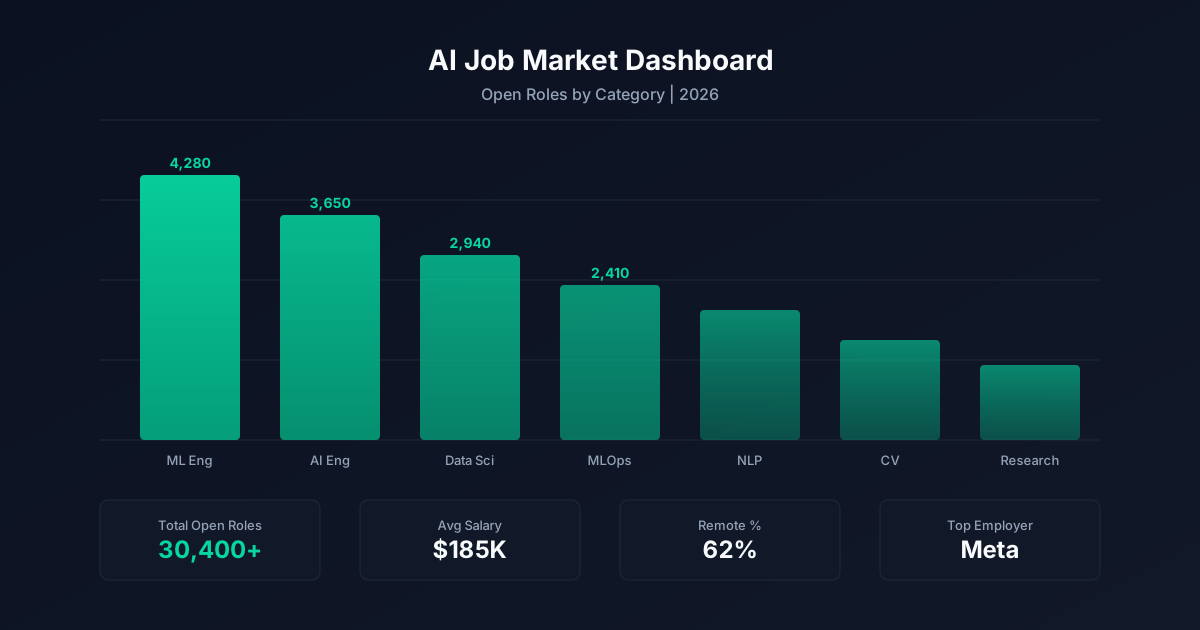
Across the 3,708 AI roles we're tracking, Data Scientist positions make up 8% of the market. At Spectrum, this role fits into their broader AI and engineering organization.
Data Scientist roles remain in high demand, though the definition keeps shifting. Companies increasingly want candidates who can bridge traditional statistics with modern ML and LLM capabilities. The 'pure insights' data scientist role is consolidating into analytics engineering, while the 'build models' data scientist role is merging with ML engineering.
What the Work Looks Like
A typical week includes: analyzing experiment results for a product feature launch, building a predictive model for customer churn, creating an automated reporting pipeline using LLM-powered summarization, presenting insights to stakeholders, and cleaning data (always cleaning data). The ratio of analysis to engineering varies by company, but expect both.
Data Scientist roles remain in high demand, though the definition keeps shifting. Companies increasingly want candidates who can bridge traditional statistics with modern ML and LLM capabilities. The 'pure insights' data scientist role is consolidating into analytics engineering, while the 'build models' data scientist role is merging with ML engineering.
Skills Required
Python, SQL, and statistical modeling are the foundation. Increasingly, roles want experience with LLMs for data analysis, automated insight generation, and building AI-powered data products. Familiarity with cloud data platforms (Snowflake, BigQuery, Databricks) and ML frameworks (scikit-learn, PyTorch) covers most job requirements.
Experimentation design and causal inference are underrated skills that separate strong candidates. Companies care about whether their product changes cause improvements, and can distinguish causation from correlation. A/B testing methodology, Bayesian statistics, and the ability to communicate uncertainty to non-technical stakeholders are high-value skills.
Good postings specify the data stack, the types of problems you'll work on, and the team structure. Look for companies that differentiate between analytics and ML data science. Vague 'data scientist' postings that list every skill under the sun usually mean the company doesn't know what they need.
Compensation Benchmarks
Data Scientist roles pay a median of $192,890 based on 463 positions with disclosed compensation. Mid-level AI roles across all categories have a median of $200,000. This role's midpoint ($122K) sits 37% below the category median. Disclosed range: $88K to $156K.
Across all AI roles, the market median is $217,500. Top-quartile compensation starts at $272,100. The 90th percentile reaches $325,000. For comparison, the highest-paying categories include AI Safety ($300,000) and Research Engineer ($280,000). By seniority level: Entry: $120,000; Mid: $200,000; Senior: $230,000; Director: $272,150; VP: $250,000.
Spectrum AI Hiring
Spectrum has 3 open AI roles right now. They're hiring across Data Scientist. Based in Greenwood Village, CO, US. Compensation range: $156K - $175K.
Location Context
Across all AI roles, 14% (508 positions) offer remote work, while 3,180 require on-site attendance. Top AI hiring metros: New York (1,045 roles, $220,000 median); San Francisco (810 roles, $277,088 median); Los Angeles (397 roles, $215,000 median).
Career Path
Common paths into Data Scientist roles include Data Analyst, Statistician, Quantitative Researcher.
From here, career progression typically leads toward Senior Data Scientist, ML Engineer, AI Product Manager.
Start with statistics and SQL. Build a real analysis project on public data that demonstrates insight generation alongside model building. The market values data scientists who can communicate findings clearly to business stakeholders. If you want to move toward ML engineering, invest in software engineering fundamentals and production deployment skills.
What to Expect in Interviews
Interviews combine statistics, coding, and business acumen. SQL is almost always tested, often with complex joins and window functions. Expect a case study round where you're given a business problem and asked to design an analysis plan. Coding rounds focus on pandas, statistical modeling, and visualization. The strongest differentiator is how well you communicate insights to non-technical stakeholders during presentation rounds.
When evaluating opportunities: Good postings specify the data stack, the types of problems you'll work on, and the team structure. Look for companies that differentiate between analytics and ML data science. Vague 'data scientist' postings that list every skill under the sun usually mean the company doesn't know what they need.
AI Hiring Overview
The AI job market has 3,708 open positions tracked in our dataset. By seniority: 102 entry-level, 1,705 mid-level, 1,469 senior, and 432 leadership roles (Director, VP, C-Level). Remote roles make up 14% of the market (508 positions). The remaining 3,180 roles require on-site or hybrid attendance.
The market median for AI roles is $217,500. Top-quartile compensation starts at $272,100. The 90th percentile reaches $325,000. Highest-paying categories: AI Safety ($300,000 median, 21 roles); Research Engineer ($280,000 median, 147 roles); AI Architect ($254,798 median, 67 roles).
Data Scientist roles remain in high demand, though the definition keeps shifting. Companies increasingly want candidates who can bridge traditional statistics with modern ML and LLM capabilities. The 'pure insights' data scientist role is consolidating into analytics engineering, while the 'build models' data scientist role is merging with ML engineering.
The AI Job Market Today
The AI job market spans 3,708 open positions across 16 role categories. The largest categories by volume: AI/ML Engineer (2,605), Data Scientist (310), AI Software Engineer (259). These three account for the majority of open positions, though smaller categories often have higher per-role compensation because of specialized skill requirements.
The seniority mix tells a story about where AI teams are in their maturity. Entry-level roles (102) are outnumbered by mid-level (1,705) and senior (1,469) positions, reflecting that most companies are past the 'build a team from scratch' phase and need experienced engineers who can ship production systems. Leadership roles (Director, VP, C-Level) total 432 positions, representing the bottleneck between technical execution and organizational strategy.
Remote work availability sits at 14% of all AI roles (508 positions), with 3,180 requiring on-site or hybrid attendance. The remote share has stabilized after the post-pandemic correction. Senior and specialized roles (Research Scientist, ML Architect) are more likely to be remote-eligible than entry-level positions, partly because experienced hires have more negotiating power and partly because these roles require less hands-on mentorship.
AI compensation is structured in clear tiers. The market median sits at $217,500. Top-quartile roles start at $272,100, and the 90th percentile reaches $325,000. These figures include base salary with disclosed compensation. Total compensation (including equity, bonuses, and sign-on) runs 20-40% higher at companies that offer those components.
Category matters for compensation. AI Safety roles lead at $300,000 median, while Prompt Engineer roles sit at $140,000. The spread between highest and lowest-paying categories reflects the premium on specialized technical skills versus broader analytical roles.
The most in-demand skills across all AI postings: Python (1,890 postings), Aws (1,103 postings), Azure (877 postings), Rag (855 postings), Gcp (631 postings), Prompt Engineering (560 postings), Pytorch (545 postings), Claude (498 postings). Python dominates, appearing in the vast majority of role descriptions regardless of category. Cloud platform experience (AWS, GCP, Azure) is the second most common requirement. The newer entrants to the top skills list (RAG, vector databases, LLM APIs) reflect the shift from traditional ML toward generative AI applications.
Frequently Asked Questions
Get Weekly AI Career Intelligence
Salary data, skills demand, and market signals from 16,000+ AI job postings. Every Monday.